---
title: "Google Says It Is Critical to Fact-Check AI Content Before Publishing"
description: "Google's generative AI content guidance now calls a manual fact-check of all AI output critical, extending the review to titles, alt text and structured data."
tldr: "Google updated its guidance on using generative AI content on 1 October 2026. It now says generative models predict likely words rather than retrieve facts, so it is critical to manually fact-check and review all AI-generated content before publishing. The review explicitly covers title elements, meta descriptions, structured data and image alt text, not only body copy."
publishDate: 2026-10-02
author: "Liam Hayward"
---
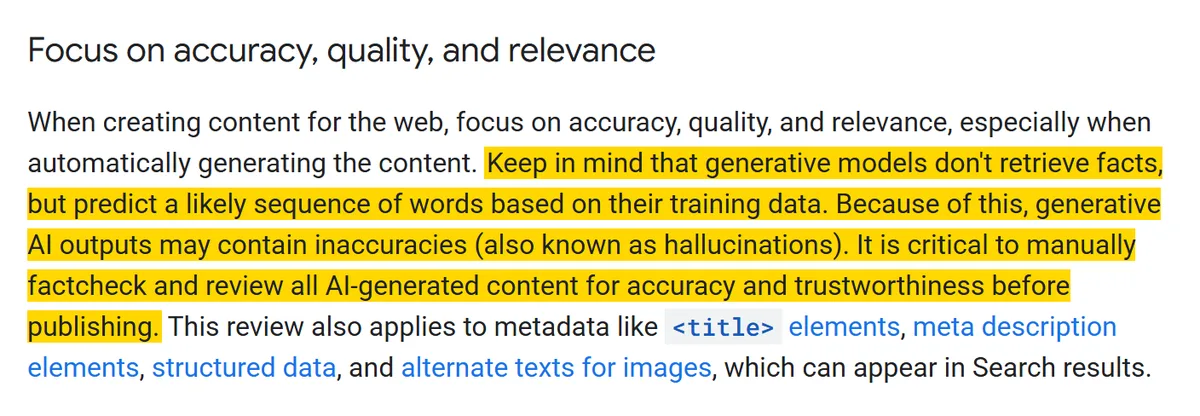
Google has added three sentences to its Search Central guidance on using generative AI content, in the "Focus on accuracy, quality, and relevance" section. They say generative models "don't retrieve facts, but predict a likely sequence of words based on their training data", that outputs "may contain inaccuracies (also known as hallucinations)", and that "It is critical to manually factcheck and review all AI-generated content for accuracy and trustworthiness before publishing." The previous version, last updated 10 December 2025, asked for accuracy but gave no manual review instruction.
The updated section of Google's generative AI content guidance. The sentences added on 1 October 2026 are highlighted.
The sentence that follows changed from "This includes metadata" to "This review also applies to metadata", listing `` elements, meta descriptions, structured data and image alt text, "which can appear in Search results." Google's documentation changelog dates the update 1 October 2026 and gives the reason as bringing the page in line with the presentations it uses at developer events.
If AI writes any of those fields on your site, from a CMS plugin that fills in meta descriptions to bulk-generated alt text, give them the same human check as the body copy. Metadata is easy to skip in review because nobody reads it on the page, and Google now names it in the same instruction as the article text.
## Sources
- [Google Search's guidance on using generative AI content on your website, Google Search Central](https://developers.google.com/search/docs/fundamentals/using-gen-ai-content#focus)
- [Previous version, last updated 10 December 2025, Wayback Machine](https://web.archive.org/web/20260927014335/https://developers.google.com/search/docs/fundamentals/using-gen-ai-content)
- [Latest documentation updates, Google Search Central](https://developers.google.com/search/updates)
- [Google Tells Sites To Fact-Check AI Content Before Publishing, Search Engine Journal](https://www.searchenginejournal.com/google-fact-check-ai-content-before-publishing/591782/)
- [Google: Manually Factcheck & Review AI-Generated Content For Accuracy, Search Engine Roundtable](https://www.seroundtable.com/google-updates-ai-content-guidelines-factcheck-review-42217.html)