Study: AI Overviews Cite Self-Serving Listicles but Recommend Competitors
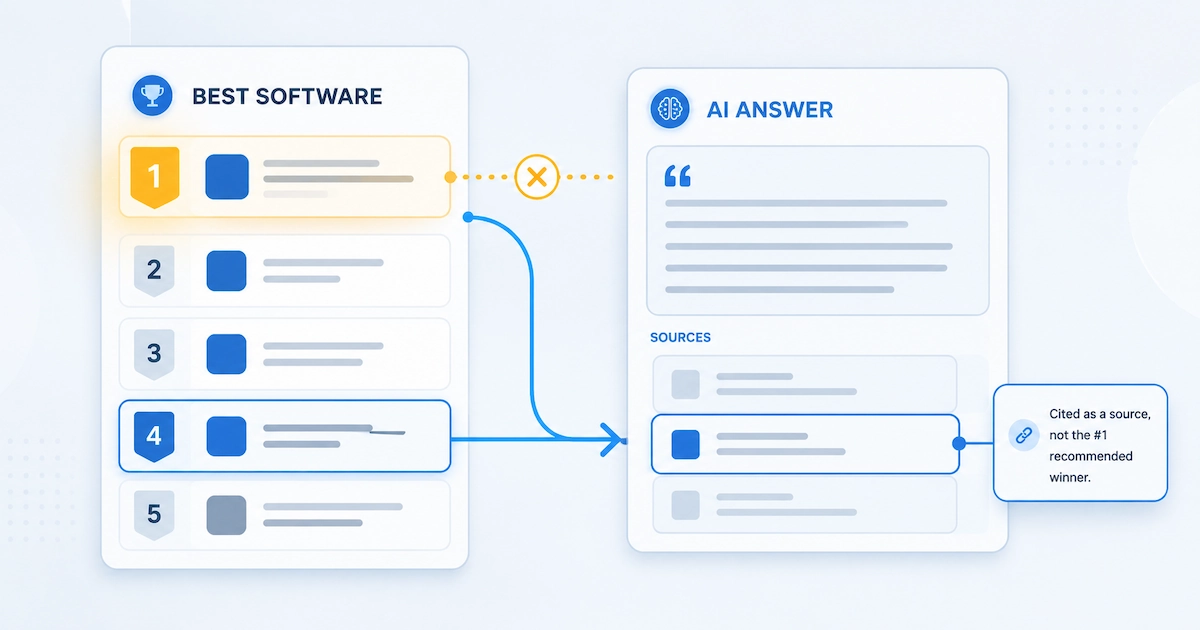
A June 2026 analysis by Lily Ray, published on her Substack and reported by Search Engine Land, found that Google’s AI Overviews routinely cite a brand’s own “best [category]” listicle as a source while declining to recommend that brand in the answer itself. The finding cuts against a long-standing content tactic: ranking yourself first in your own “best of” roundup.
This matters because being cited and being recommended are not the same outcome. A page can supply the source material an AI Overview is built from and still watch the recommendation go to a competitor.
What the study found
Ray analysed 100 B2B “best [category] software” queries across three snapshots: 15 April, 15 May, and 8 June 2026. Of the roughly 80 prompts that triggered an AI Overview:
- Brands’ own self-promotional listicles were cited 323 times.
- In 224 of those cases, the brand was cited as a source but not recommended in the answer.
- Across the run, the pattern held for the large majority of self-promoters, around 69% of cases.
Where brands were left out, Google’s AI Overviews leaned on third-party and user-generated sources. Reddit citations rose sharply over the period, with Forbes and YouTube also among the most-cited domains for “best” queries. Ray noted that declines for self-promotional listicles continued and accelerated through Google’s May 2026 core update.
A separate, independent analysis of 232,000 citations by Peec AI reached the same broad conclusion, which strengthens the finding beyond a single dataset.
Why this happens
The behaviour is consistent with how AI answers weigh sources. An AI Overview can draw factual detail (feature lists, pricing, categories) from a brand’s own listicle while treating the recommendation question separately, where it favours sources that read as independent. A page that names itself the best is useful as structured input but weak as an impartial verdict, so it gets mined for facts and skipped for the endorsement.
That is also why community and editorial sources do well here: Reddit threads, Forbes roundups, and YouTube reviews carry the independence signal that a self-published “we’re number one” page lacks.
What this means
The lesson for generative engine optimisation is to aim to be the cited authority, not the self-promoter. A few practical implications follow:
- Self-serving “best [category]” listicles that place your own product first can still earn citations, but should not be relied on to win the recommendation. Treat them as fact-supply, not endorsement.
- Genuinely comparative, even-handed content has a better chance of being both cited and recommended. Neutral framing is a GEO signal, not just an editorial nicety. This applies to the listicle and comparison formats specifically.
- Earned third-party visibility (credible reviews, community presence, mentions on sites users trust) increasingly drives which brand an AI answer recommends, which raises the value of off-page reputation alongside on-page content.
The wider point is that AI answers are pulling apart two things SEO used to treat as one: appearing in the result and being the answer. Optimising only for the citation leaves the recommendation on the table.
Sources
More news
-
Claude's Usage Policy Now Bars Seeding Search and AI Answers Through Fake-Independent Sites
From 12 November, Claude's Usage Policy bars swaying search and AI answers through sites posing as independent, and drops publishing from its high-risk list.
-
Google Tests Paying Publishers Through an AI Contribution Pilot
Google is running an invite-only Search Console pilot that pays some publishers when their content shapes an AI Overview, AI Mode or Gemini answer.
-
People Also Ask Answers Hit 97% AI-Generated, After April's Slump to 11%
AlsoAsked measured 97% of English PAA answers as AI-generated in early September, up from 11% in April. The same curve has reversed twice this year.