Featured Snippets
Last updated
A featured snippet is an answer box that appears above the first organic result in Google Search. It pulls a passage, list, or table directly from an indexed page and displays it inline on the results page, with a link to the source. They are often called “position zero” because they sit before the standard ranked list, though since January 2020 a featured snippet replaces the source page’s ordinary listing rather than adding a second one, so it functions as that page’s single top placement, not a bonus slot.
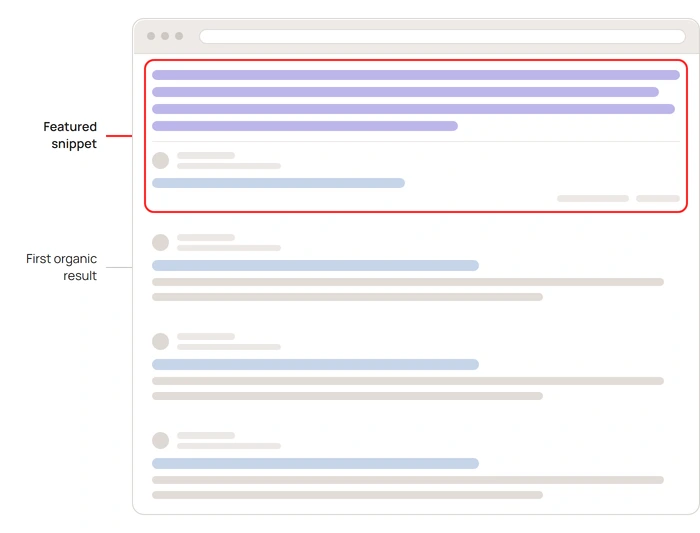
Featured snippets appear for queries where Google determines a direct factual answer exists. Definitional queries (“what is X”), how-to queries (“how do you X”), and comparison queries (“X vs Y”) are the most common triggers. They do not appear for all queries, and their prevalence varies considerably by category.
What types of featured snippets are there?
Google displays three main featured snippet formats, each suited to a different query type.
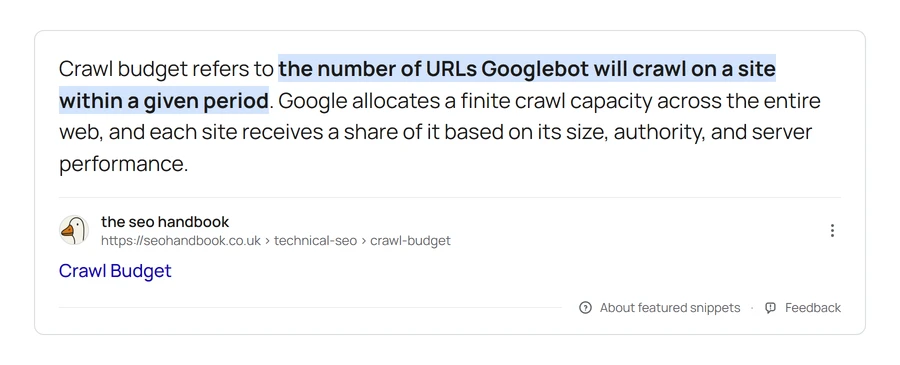
Paragraph snippets are the most common. Google extracts a block of roughly 40–60 words that answers the query directly. These appear most often for definitional and explanatory queries. The extracted text typically comes from the paragraph immediately below a question-shaped heading.
List snippets appear for process and ranked queries. Ordered lists (“how to do X in five steps”) and unordered lists (“best X for Y”) both surface in this format. Google typically shows five to eight items before truncating with a “More items” link. Lists that exceed eight items are frequently truncated.
Table snippets appear for comparison and data queries. Google renders the table inline and displays a condensed version, typically three columns and five to six rows. Cells with long content are truncated.
A fourth type, video snippets, appears for how-to queries and pulls a timestamped clip from a YouTube video. These are subject to different optimisation logic and are covered in the visual search article.
How do you optimise for featured snippets?
There is no direct submission process. Google selects snippet sources algorithmically. The practical approach is to match content format to the query type you are targeting. Snippets are one of several features that can be targeted this way, and the SERP feature targeting guide covers the formatting each of the others rewards.
Use question-shaped headings. An H2 or H3 phrased as the query itself (“What is crawl budget?”) signals directly to Google’s extraction system. A heading like “Crawl Budget Explained” provides weaker signal for that specific query. See the headings guidance in the People Also Ask article, which shares the same content signals.
Answer immediately and directly. The first sentence after a question-shaped heading should answer the question without preamble. Avoid “it depends”, restating the question, or building to the answer. Place the direct answer first; add nuance in subsequent sentences.
Match format to intent. For definitions, use a paragraph of 40–60 words. For processes, use an ordered list where each item is one concise step. For comparisons, use an HTML table with a heading that names the comparison. Google’s extraction system selects the format from the page, so if the query is a process query and your answer is a paragraph, you are competing against pages with ordered lists.
Keep answers self-contained. Extracted passages appear without their surrounding context. An answer that begins “As mentioned above…” or relies on a table defined elsewhere on the page will not read cleanly as a snippet.
Target queries where you already rank. Google selects snippet sources automatically; you cannot submit a page.1 In practice it draws them from pages that already rank well for the query, typically on the first page, so snippet optimisation is most effective on pages that are already ranking rather than a route to visibility from outside the first page.
How have AI Overviews affected featured snippets?
Featured snippet visibility declined significantly as AI Overviews expanded through 2025. Ahrefs compared 1,000,000 randomly chosen US desktop SERPs between January and June 2025 and found featured snippets on 5.53% of them, down from 15.41%, a fall of 64% in six months. Over the same period and the same sample, AI Overviews moved the other way, from 3.93% to 27.43%.2
However, the two features are not straightforwardly in competition. The same content signals earn both: a direct answer under a question-shaped heading, clear structure, and topical authority. Snippet and AI Overview placements frequently co-occur on the same SERP,3 and optimising for one is effectively optimising for the other.
When an AI Overview appears, click-through to the source pages drops even for cited results.4 But appearing in both the snippet and the AI Overview still outperforms appearing in neither, and the brand exposure from those placements has value independent of the immediate click.
Do not deprioritise snippet optimisation because of AI Overviews. The content approach is identical, and pages that hold snippet positions are better positioned for AI Overview citation.
Featured snippets and voice answers
Spoken answers on Google’s assistants have historically been read from featured snippet positions, so holding the snippet has been the mechanism for appearing as the voice answer. That link is loosening as Google’s smart speakers move from Google Assistant to Gemini, which generates conversational answers rather than reading a single snippet aloud (see voice search).
The formatting that helps either way is the same: a concise, direct answer in plain prose, positioned under a question-shaped heading. Paragraph snippets translate to speech better than lists or tables.
How do you track featured snippet performance?
Google Search Console does not label featured snippet traffic separately. Clicks from snippet positions appear as organic clicks for the underlying query.
To identify whether a page holds a snippet: run the target query in a private browsing session and check whether your page is the snippet source. Third-party tools (Semrush, Ahrefs) track snippet ownership at scale and can flag changes, gains, and losses across your keyword set.
Track snippet presence alongside impressions rather than clicks alone. A page that holds a snippet for a high-volume query but sees low CTR may still be delivering brand exposure worth retaining. The same applies to queries where an AI Overview appears alongside the snippet.
Frequently asked questions
Does schema markup help earn featured snippets?
There is no schema type for featured snippets. Google’s extraction is based on page content and structure, not markup. Well-structured prose under question-shaped headings consistently outperforms schema-tagged but less clearly written content.
Can I opt out of featured snippets?
Yes. The nosnippet meta robots directive prevents Google from displaying any snippet from a page. The max-snippet directive limits the character length of extracted text. Both are signals to Google’s systems, not guarantees.
Does holding a featured snippet improve my organic ranking?
Snippet selection and organic ranking are separate systems. You can hold a snippet while ranking anywhere on the first page. In some cases, snippet selection is associated with ranking improvements, but there is no confirmed causal relationship.