Bing Webmaster Tools Now Lists AI Search Queries Where Other Sites Are Cited and Yours Is Not
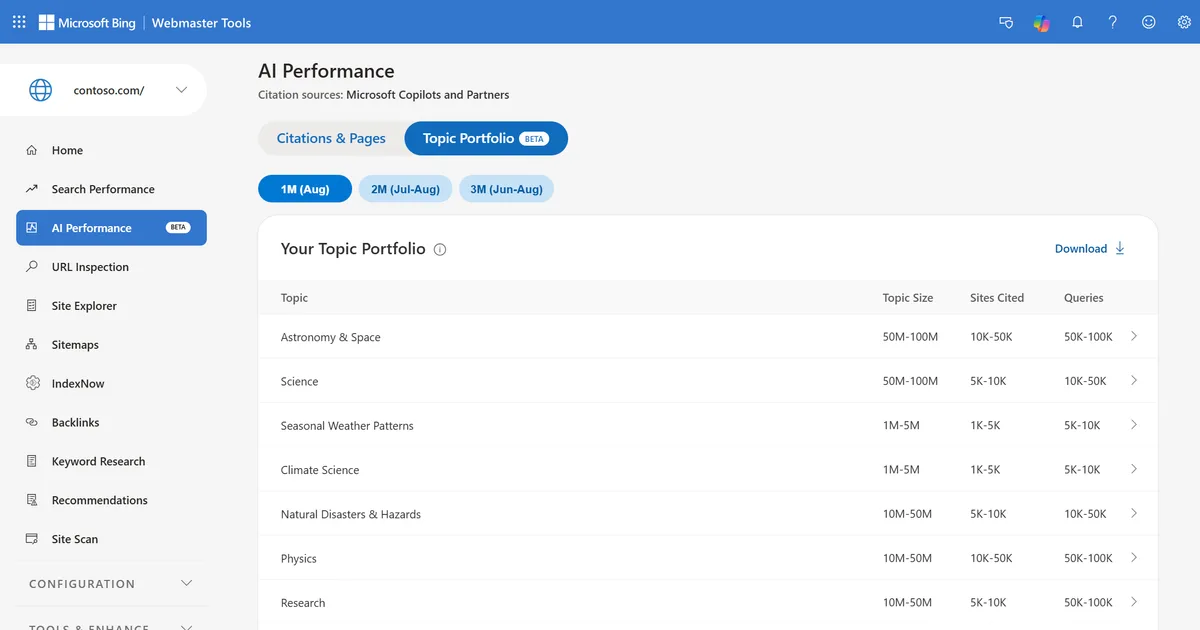
Microsoft has added a beta tab called Topic Portfolio to the AI Performance report in Bing Webmaster Tools, announced as Topics Portfolio on the Bing Webmaster blog by the Microsoft Bing team’s Krishna Madhavan, Saral Nigam and Vivek Jain. The Topics view that arrived in June grouped only the grounding queries a site was already cited for. Topic Portfolio adds data from outside the site: each topic’s Topic Size (approximate citations across all sites), Sites Cited (approximately how many sites appear for it) and Queries, and a Top Opportunity Queries list of grounding queries in your topics where other sites are cited and yours is not, with citation volumes shown as ranges. It shows one, two or three months of data, and only appears where, in Microsoft’s words, “there is sufficient data for your site”, so smaller sites may see few topics or none.
If your site is verified in Bing Webmaster Tools, the opportunity list is a ready-made gap list for Copilot and Bing’s AI summaries: queries in subjects you already cover where Bing’s AI cites someone else. Microsoft’s own caveats decide how to use it. The topics are AI-generated and can misfile queries, rival brands’ queries can appear as opportunities (its example is a shoe retailer shown a competitor’s brand search under Running Shoes), and it says to “treat the numbers as directional signals for planning, not as a precise ledger”. Sort the list for queries a page of yours should answer and does not, discard the brand queries, and use Topic Size to compare subjects rather than to forecast citations. There is still no click data, and the figures cover Microsoft’s surfaces only, not Google’s AI features or ChatGPT.
Sources
More news
-
Google Tag Manager Can Now Send Google Data Without Loading gtag.js
Since 12 October 2026, Tag Manager can send data to Google Analytics and Ads without loading gtag.js. The switch is opt-in; check three things first.
-
Rank Trackers Are Being Served Altered Google Results
Nozzle and DemandSphere report Google returning normal-looking results pages with the wrong results to rank trackers since September 2026.
-
Search Console Reports Hallucinated URLs as Real Pages
Search Console listed six hallucinated URLs on The SEO Handbook alongside real pages, with impressions. What that means for page-level data.