Search Console Now Reports Searches Made With Lens and Circle to Search
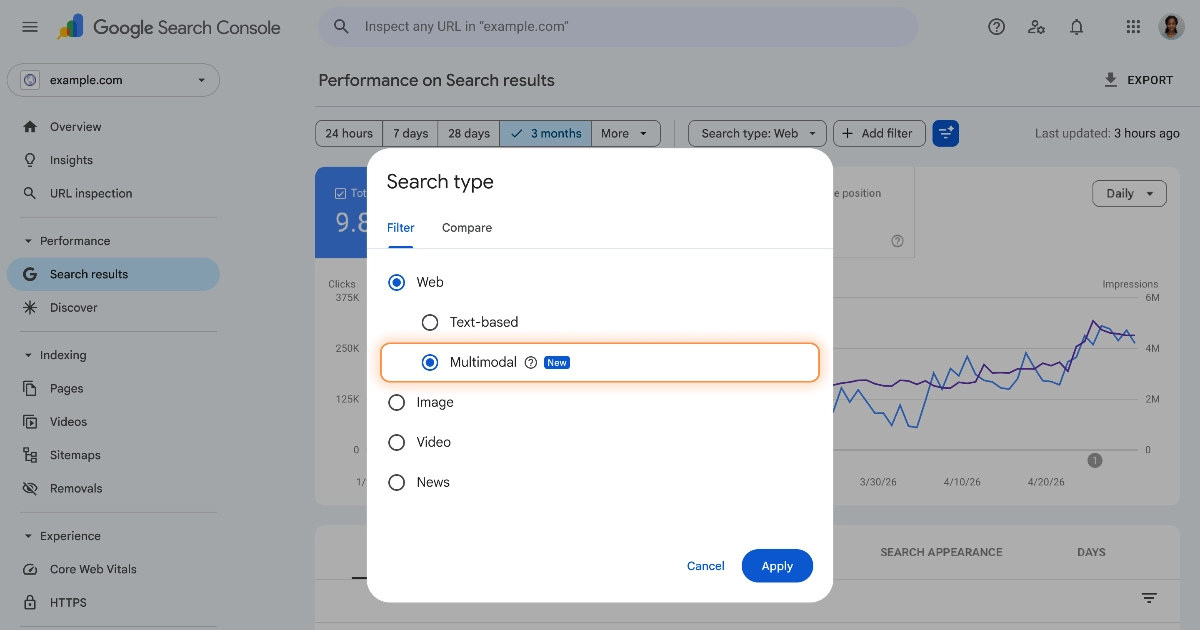
Search Console now shows how a site performs when people search with an image rather than typed text. Google announced the change on 24 September 2026 and says it is rolling out globally from that date. Until now, Lens and Circle to Search traffic had no filter of its own in Search Console, so it could not be separated out.
What the multimodal filter covers
In the Performance report, the Search type filter’s Web option now has two sub-options: Text-based, for queries typed into the standard search bar, and Multimodal, which Google’s help documentation defines as “web search results where an image was used as part of the search”. Four entry points feed it:
- Google Lens
- Circle to Search on Android
- Image uploads to Google Search
- Chrome’s right-click “Search this image”
The same filter is available in the Generative AI features report, so image-led searches that surface a page in AI Overviews or AI Mode can be viewed separately too. Google says the metrics appear only for sites that receive traffic from these searches, so an empty view is not necessarily a fault.
This is distinct from the existing Image search type, which covers the Images tab in Google Search and sits alongside Web rather than under it.
What the report does not show
There is no query data. Google’s documentation says that because multimodal searches mostly use images rather than text, “the queries dimension isn’t available when this search type is selected.” Google’s John Mueller confirmed on LinkedIn that the pages which appear are reported, and that is where the useful detail sits.
The Search Console API is also behind. The Search Analytics reference lists web, image, video, news, Discover and Google News as its types, with no multimodal option as of 24 September 2026. Google’s announcement points to the Export button for analysis in other tools, so for now this is UI and export data only, and API-fed dashboards will not pick it up.
Google’s Search Central LinkedIn post adds that the same data is available for platform properties, the Search Console property type for social and video accounts, naming YouTube, Instagram and TikTok.
What to check in your own property
Open Performance, set Search type to Web, then Multimodal, and go to the Pages tab. The pages listed are the ones earning visibility when someone points a camera at, circles or uploads something your site covers. For product, recipe, travel and other image-led sites, that list shows which pages image search actually reaches, which is the evidence usually missing when image quality competes for development time.
One question is still open. Search Engine Roundtable reports that the multimodal figures are new data rather than a slice carved out of the existing Web totals. Google has not said either way. Before rebasing any report on Web: Text-based, compare its totals for a past fortnight against your own recorded Web figures for the same dates.
Sources
- Announcing web multimodal Search performance reporting in Search Console, Google Search Central Blog
- Performance report (Search results): Overview and basic setup, Search Console Help
- Performance report (Search results): Dimensions and data groupings, Search Console Help
- Search Analytics: query, Search Console API reference
- Google Search Central on web multimodal search reporting, LinkedIn
- John Mueller, resharing the Search Central post with comment, LinkedIn
- Multimodal Search Type Filter In Google Search Console Performance Report, Search Engine Roundtable
More news
-
Shopify Changes How It Counts Sessions, Moving Conversion Rates
Shopify Analytics changed how it counts sessions from 21 September 2026, so conversion rate can move with no change in orders or sales.
-
Google Analytics 4 Adds Include Filters for Hostnames
Google Analytics 4 now lets you allowlist approved hostnames with an Include data filter, rather than only excluding unwanted ones.
-
Google Adds Four Experimental Ad-Experience Metrics to CrUX
Google has added four experimental ad-experience metrics to the CrUX field dataset, measuring how a page's ads affect real users' page experience.