ChatGPT Now Cites Twice as Many Sources, and Listicles Lost Half Their Share
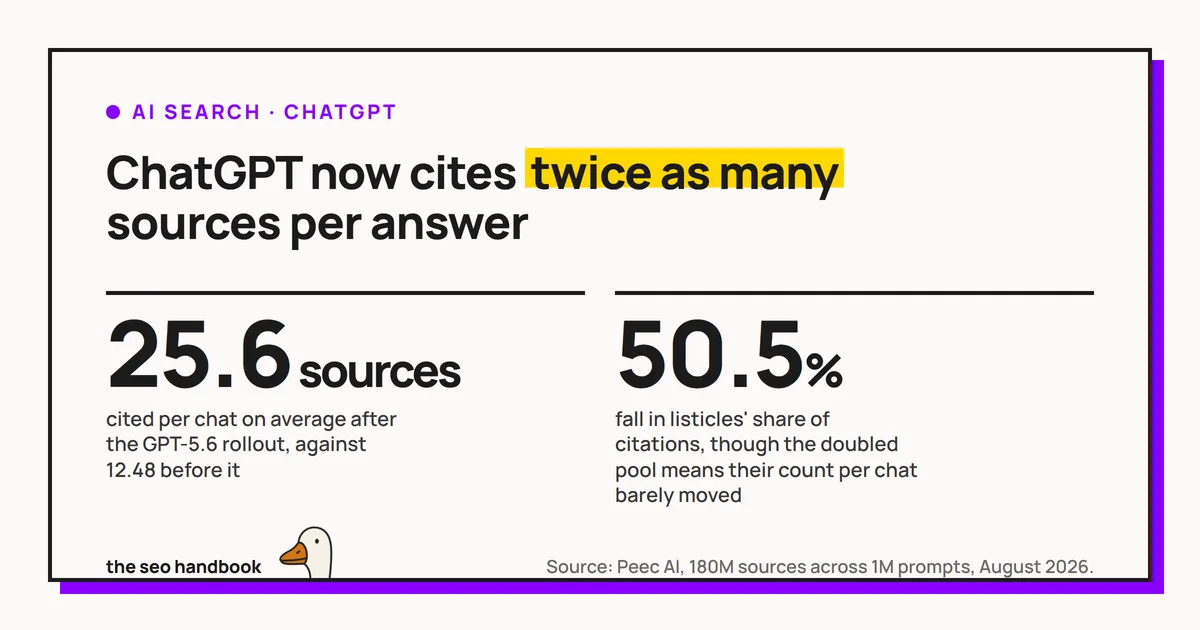
The most useful thing to come out of the GPT-5.6 rollout is not a figure about any one website. It is that ChatGPT changed the words it searches with, dropped the ones an entire content format was built around, and roughly doubled the number of sources it cites per answer. The last of those three is what decides how to read the other two.
What the fan-out data shows
Chris Long of Nectiv ran the cleanest before-and-after available, because he already had a baseline. In 2025 he analysed how ChatGPT decomposes a prompt into background searches. In August 2026 he took roughly 4,000 of the same prompts, kept the representation across verticals equal, and ran them against GPT-5.6 Sol, pulling the fan-out queries from OpenAI’s API.
The volume changed first. The average number of fan-out queries per prompt went from 2.17 to 7.61. The longest chain in the dataset went from 4 searches to 29. Average words per query rose more modestly, from 5.48 to 6.82. Software prompts drew the most searching at 10.7 queries on average, ahead of real estate at 8.7 and fashion at 8.5, while travel and credit cards sat below six.
The vocabulary changed more interestingly. Long extracts the unigrams that ChatGPT introduces which were not in the original prompt, on the reasoning that these show the nomenclature the model reaches for. In 2025 the common terms were reviews, year, free, features and comparison. In 2026 site:, official and gov all sit in the top five, with site: appearing in 64% of all fan-out queries and official the second most searched term. Long notes the two lists barely overlap.
Freshness moved down rather than out. Year signals used to be the single most common addition and now sit outside the top five, and ChatGPT has started running multi-year searches, looking for both 2026 and 2025 rather than the current year alone.
What happened to listicles and comparison pages
Tomek Rudzki of Peec AI describes the same shift from the other end. The fan-out terms that fell the most as a share of all queries were vs, comparison, top, best and reviews. The share of top fan-outs alone fell 75%, and the average number per chat fell 36.5%.
Set that list beside Long’s 2025 baseline and it is nearly the same list. The terms ChatGPT used to add are the terms it has stopped adding.
Rudzki’s figures for the other direction match Long’s from a different dataset: 18.37% of chats now include at least one site: fan-out, against almost none before, and GPT-5.6 runs about 154% more fan-outs per chat than GPT-5.5.
Citation share moved with them. Rudzki reports citations classified as listicles falling from 15.77% to 7.80%, a 50.5% relative decline, and comparison pages from 9.08% to 6.17%, a 32.1% decline. The analysis covers 180 million sources across the same set of one million tracked prompts, compared week-before against week-after the rollout. David Konitzny of Peec AI has product pages now making up 16.39% of retrieved pages, moving ahead of listicles.
“10 best [category] tools” and “[brand X] vs [brand Y]” are precisely the two page types produced at scale over the past two years to win AI citations. Peec AI’s own May 2026 research had found that best was the word ChatGPT most often injected into searches the user never typed, and concluded that this was why listicles dominated AI answers. The term it identified as the cause has now dropped away.
Diluted, not dropped
The word doing the work in all of those numbers is share, and a second figure in Rudzki’s data changes what the fall means.
GPT-5.6 cites 25.55 sources per chat on average, against GPT-5.5’s 12.48. The pool roughly doubled. A share can halve while the underlying count holds steady if the thing it is a share of has twice as many members, and that is close to what these figures describe. Multiplying the shares by the sources per chat puts listicle citations at about 1.97 per chat before and 1.99 after, a difference of one part in eighty. On the same arithmetic comparison pages rise, from roughly 1.13 to 1.58.
That is an estimate, not a measurement. Multiplying an average by a share is approximate, and it assumes both figures describe the same denominator in the same dataset, which Rudzki does not state either way. The direction is clear enough to matter, though. Listicles have not stopped being cited. They have been diluted, cited at roughly the same rate inside answers that now carry twice as many sources.
The practical difference is real. “Your roundup gets cited half as often” would be a reason to stop making them. “Your roundup gets cited about as often, but now sits alongside twice as many other sources, many of them the brand’s own pages” is a reason to expect it to carry less weight in the answer, which is a different problem with a different fix.
This site covered the previous chapter of that story in June, when SEO specialist Lily Ray’s analysis found Google’s AI Overviews citing brands’ own “best of” listicles while recommending a competitor around 69% of the time. The failure mode then was being cited without being recommended. The failure mode now is being cited among a crowd.
Why ChatGPT’s source selection could change overnight
The mechanism has an unusually good explanation, and it comes from reading ChatGPT’s own network traffic rather than from measuring its output.
Suganthan Mohanadasan, co-founder of the AI SEO agency Snippet Digital, found that every ChatGPT conversation carries two hidden system messages that never appear in the interface, one of them named sources_and_filters_prompt. He can demonstrate the slot exists, counting 64 instances across his last 30 conversations, but not read it: OpenAI strips the contents server-side and ships only the envelope.
He can watch it execute, though. The fan-out queries in his own capture append the kind of source the model wants rather than just rewording the question, with official bolted onto factual queries 17 times across his census. The pattern he describes, facts routed to official pages and opinions routed to reviews and Reddit, is the same one visible in Long’s unigrams and in Ray’s site: findings from an entirely different direction.
If that reading is right, source selection is a policy rather than a behaviour. It lives in an instruction OpenAI can rewrite on any given day without retraining a model or telling anyone, which is exactly what a change that arrives fully formed overnight looks like. It also means, as Mohanadasan puts it, that nobody can honestly sell you ChatGPT’s ranking factors, because the real instructions are a named object that never leaves OpenAI’s servers.
How much weight the fan-out and citation studies hold
Five cautions, in descending order of how much they should change your reading.
The citation-share figures are single-sourced. Rudzki states his sample, 180 million sources across one million tracked prompts held constant across the two weeks, which is more than most figures in this category carry. It is still one company’s dataset published as a LinkedIn post rather than a report, and no one has reproduced it. The direction is corroborated by Long’s independent unigram shift; the specific percentages are not.
Share is not count. The headline percentages describe citation share, and the pool of cited sources roughly doubled over the same period, so a falling share is not evidence of falling citations. The arithmetic above is the site’s, not Rudzki’s, and he has not published a per-chat count for either format.
Several of the “independent” sources are one organisation. Tomek Rudzki, David Konitzny and Malte Landwehr all work at Peec AI. Nectiv, Ahrefs and Mohanadasan are genuinely separate; a good deal of the rest traces back to a single company with a product to sell in this category.
Collection method decides the numbers. Long’s site: figure of 64% comes from OpenAI’s API, which is clean and repeatable. Tools that scrape the consumer interface report the same operator between 16% and 24%. Neither is wrong; they are different denominators, and two studies using different methods should not have their percentages compared directly.
Not everyone’s ChatGPT is the same ChatGPT. Mohanadasan compared his own account against two readers’ and found three different retrieval pictures: a free account in Italy, his paid account in the UAE and a third in Germany each showed a different mix of retrieval sources, with one pipeline not being served to his account at all. Panel data describes the cohorts a panel happens to sample.
What to do about the fan-out shift
Nothing here justifies deleting a page that earns traffic. Comparison and roundup content that people actually read still works as content; what has changed is its standing as a route into ChatGPT’s answers, on one model, measured over roughly two weeks.
The instruction that does follow is narrower and more durable. If ChatGPT is searching site:yourdomain.com and appending official to factual queries, then your pricing, specifications, model numbers and support details need to be in plain crawlable HTML on pages that are unmistakably yours, rather than locked in an image, rendered client-side, or left implied. Ray’s version of this point is worth borrowing directly: if you will not publish a price, say “starts at £5,000” rather than “contact sales”, because a stray forum comment about your product costing £20,000 gets repeated as fact when your own page declines to say otherwise.
The wider lesson is about how fast this can move. The behaviour described here arrived inside a single day, was never announced, and sits in an instruction that can be rewritten the same way. Date every claim you rely on, including this one, and re-test rather than assuming.
Sources
- ChatGPT Tripled Its Fan-Out Queries and Looks For Authoritative Sources — Nectiv
- What We Can Learn from Evolving ChatGPT Fan-Out Queries — Lily Ray
- ChatGPT is falling out of love with listicles — Tomek Rudzki, Peec AI, on LinkedIn
- New Peec AI data on declining fan-out terms, listicles and comparison pages — Lily Ray on LinkedIn
- ChatGPT Changed How It Picks Sources While You Were Reading My Last Post — Suganthan Mohanadasan
- Patterns we see in ChatGPT query fanouts — Peec AI
- Why ChatGPT Cites One Page Over Another (Study of 1.4M Prompts) — Ahrefs
More news
-
Claude's Usage Policy Now Bars Seeding Search and AI Answers Through Fake-Independent Sites
From 12 November, Claude's Usage Policy bars swaying search and AI answers through sites posing as independent, and drops publishing from its high-risk list.
-
Google Tests Paying Publishers Through an AI Contribution Pilot
Google is running an invite-only Search Console pilot that pays some publishers when their content shapes an AI Overview, AI Mode or Gemini answer.
-
People Also Ask Answers Hit 97% AI-Generated, After April's Slump to 11%
AlsoAsked measured 97% of English PAA answers as AI-generated in early September, up from 11% in April. The same curve has reversed twice this year.