People Also Ask Answers Hit 97% AI-Generated, After April's Slump to 11%
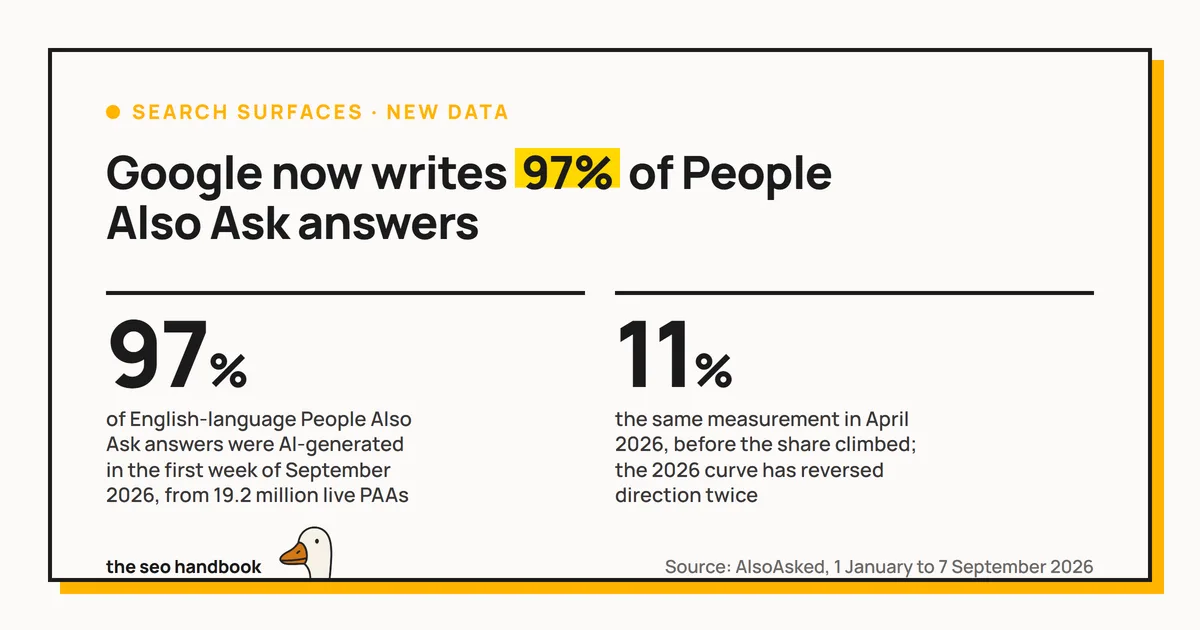
Google wrote 97% of the People Also Ask answers AlsoAsked sampled in the first week of September 2026, rather than extracting them from an indexed page. In April the same figure was 11%.
Mark Williams-Cook, who founded AlsoAsked, published the monthly series on LinkedIn on 8 September, drawn from 19.2 million live English-language PAAs collected between 1 January and 7 September 2026. His reading of it: “It seems highly likely we are on track for 100% shortly.”
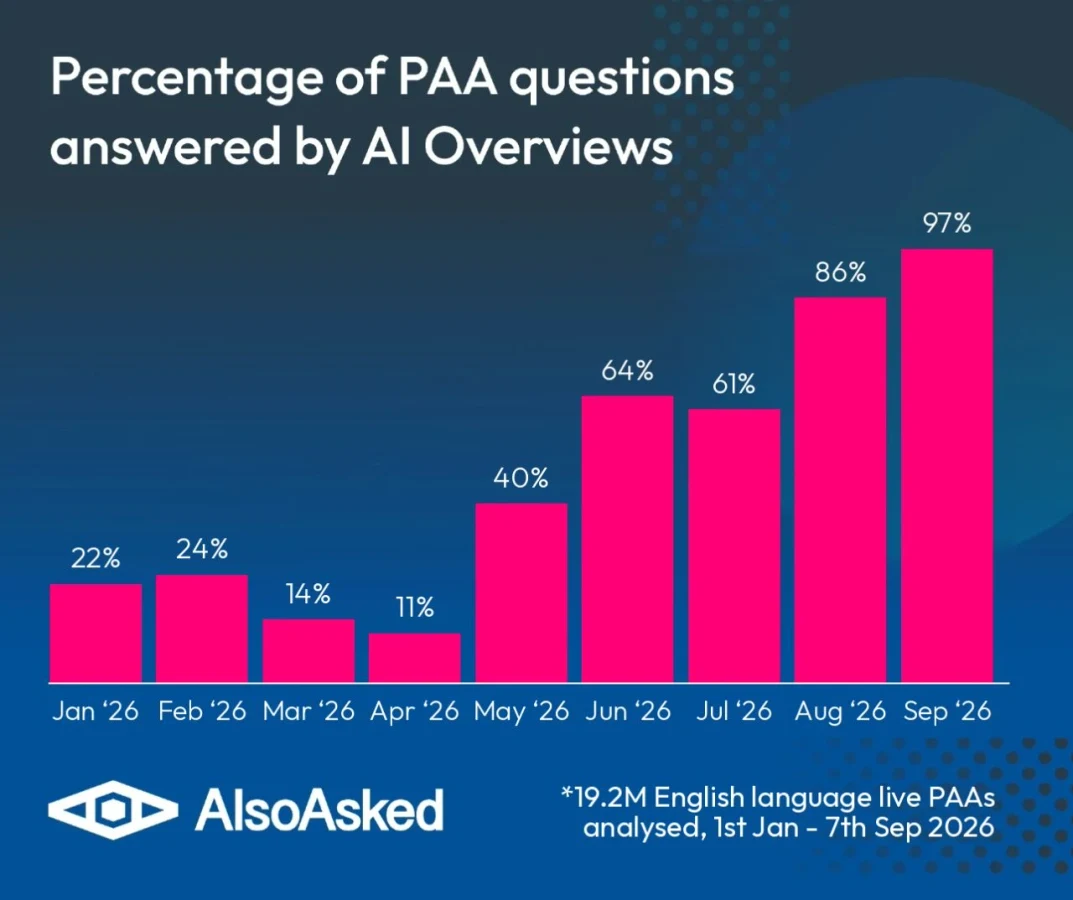
The trajectory is the story, and so is the fact that it has gone backwards twice inside the same dataset.
What AlsoAsked is counting
The classification is Google’s own. Since November 2024 Google has powered some PAA answers with AI Overviews, and those answers carry an AI-generated label rather than presenting an extracted passage attributed to one page. AlsoAsked splits every answer in its sample into that AI-generated bucket and a website-cited bucket, which is the wording Williams-Cook has used for the measurement since the first instalment.
That first instalment, in July 2025, put AI-generated answers at 12.6% of roughly 8.4 million live English-language PAAs. By October 2025 AlsoAsked reported 38%, up from 17.8% earlier in the year.
Three scope conditions travel with the new figure. It is AlsoAsked’s own panel, not a Google disclosure. It is English-language only. And the September bucket covers seven days against full months everywhere else in the series.
The curve fell before it climbed
Read month by month, the 2026 series is not a ramp:
| Month | AI-generated share |
|---|---|
| January | 22% |
| February | 24% |
| March | 14% |
| April | 11% |
| May | 40% |
| June | 64% |
| July | 61% |
| August | 86% |
| September (1–7) | 97% |
Between February and April the share fell by more than half, and July came in below June. Because all nine points come from one 19.2 million PAA sample collected on one methodology, that dip is not an artefact of comparing different studies. Something in Google’s rollout went backwards for a quarter of the year and then advanced faster than it had before.
The cross-sample comparison points the same way and is weaker for it. AlsoAsked’s October 2025 reading of 38% sits well above its own January 2026 reading of 22%, but those are separate collections and the drop between them could as easily be a change in what was sampled as a change in what Google shipped. The within-sample fall from 24% to 11% is the one that cannot be explained that way.
None of this makes the September figure wrong. It does mean the series has already reversed direction twice this year, which is a poor basis for extrapolating the next point.
What is not established
Google has documented nothing. There is no announcement, help-centre change or Search Central post covering an expansion of AI-generated PAA answers. The only account of what happened is a measurement taken from outside.
The measurement has no published methodology. Both the October 2025 and September 2026 figures were released as LinkedIn posts with a chart. How live PAAs were sampled, which queries generated them and how the AI-generated label was detected are not written down anywhere a reader can check. AlsoAsked scrapes live PAA data as its core product, so it is well placed to run this, and that is a reason to take the direction seriously rather than a substitute for a method.
Whether these answers still link out is a separate question from whether they are extracted. AlsoAsked’s split is AI-generated against website-cited, which establishes that the text is no longer lifted from a single page. It does not establish that the box has stopped carrying source links altogether, and AI Overviews elsewhere in Search do carry them.
The figure is English-language. Google has rolled AI features out at different speeds across languages before, and nothing here measures what non-English PAA boxes are doing.
What 97% AI-generated answers mean for question-shaped content
The practical change is narrower than it looks, and it is not the end of writing question-shaped headings.
Question-shaped headings with a direct answer underneath still earn featured snippets, still feed AI Overviews, and are still how a passage gets retrieved and quoted by an AI assistant. What is going is one specific justification for writing them: that a well-formed 40 to 60 word answer under an H2 gets extracted verbatim into a PAA slot with your page named beside it. On these numbers, that slot is nearly gone. The heading advice survives; the PAA rationale for it does not.
PAA’s second use is untouched. The box still reveals which questions Google associates with a topic, and it still expands in real time as questions are clicked, so it remains a way to map a subject’s question space whether or not Google writes the answers. AlsoAsked’s own product rests on that behaviour rather than on the citation.
If PAA visibility was something you reported on, check your own Search Console data before acting on a panel average. A share measured across 19.2 million PAAs says nothing about which boxes your pages sat in, and a fall in a tracked share is not a measurement of your domain.
The wider caution is one this site keeps arriving at: a figure like this comes from a company measuring its own monitoring set, in one language, over a window it chose, and describing a surface configured by someone else. That is a reason to watch the direction, not to rebuild a content plan around the next data point in a series that has already turned round twice.
Update: a second panel measured the same shift a different way (September 2026)
Saeed Khosravi of Allintitle published a parallel series on 8 September, and Search Engine Roundtable put the two side by side the following morning. Allintitle’s headline is the stronger one: “Google People Also Ask Answers Are 100% AI Generated” from August 2026. Asked directly by Barry Schwartz, Williams-Cook declined that reading and put his own 19.2 million PAA dataset at 97%, “almost at 100% but not there yet”.
The more useful difference is what the two are counting. AlsoAsked reads live PAA boxes and classifies the answers in them. Allintitle measures the success rate of Google’s legacy PAA endpoint, the request path that returned a text snippet extracted directly from a web page, across a sample of 6,092 PAA questions, by checking the saved raw server responses behind the calls. That endpoint returned an extracted snippet 69.7% of the time in November 2025, peaked at 80.6% in February 2026, fell to 25.8% in July, and has returned nothing at all since: 0.0% in both August and September.
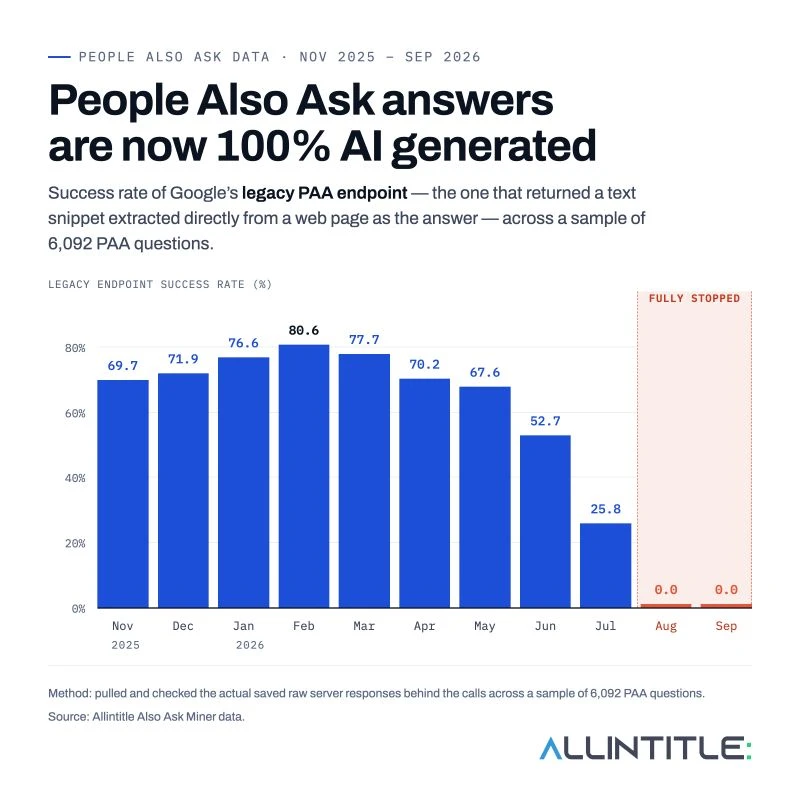
On direction the two agree, and Allintitle’s method is the better-documented of the pair. On the detail they do not agree, in two places.
Allintitle’s series contains no equivalent of the February to April dip. Its legacy success rate peaked in February and declined from there, which implies AI-generated answers rising across exactly the window in which AlsoAsked recorded them falling from 24% to 11%. The dip is real in AlsoAsked’s data and is not reproduced in Allintitle’s.
The two conflict outright on August. Allintitle has the legacy endpoint at zero, while AlsoAsked still has 14% of August answers as website-cited. Both can hold only if some extracted answers now reach the box by a route other than that endpoint, which neither panel measures. The lesson is the ordinary one for competing panels: a shared direction across two independent datasets is worth more than either level, and neither is a measurement of Google’s internals.
Sources
- Massive change by Google: we are likely to see 100% AIOs within “People Also Ask” answers — Mark Williams-Cook, AlsoAsked, on LinkedIn
- Allintitle’s data shows that as of August 2026 Google People Also Ask answers are 100% AI generated — Saeed Khosravi, Allintitle, on LinkedIn
- Almost 100% Of People Also Ask Results Are Answered By Google AI Overviews — Search Engine Roundtable
- New AlsoAsked data on Google AI Overviews in People Also Ask — Mark Williams-Cook (LinkedIn)
- AI-Generated Google People Also Ask Almost Doubles In 3 Months — Search Engine Roundtable
- Over 12% Of People Also Ask Results Are Google AI Overviews — Search Engine Roundtable
- Google generates nearly 13% of People Also Ask answers: Data — Search Engine Land
More news
-
ChatGPT Now Cites Twice as Many Sources, and Listicles Lost Half Their Share
GPT-5.6 searches more and scopes searches to specific domains. Listicles and comparison pages lost citation share, but the pool they compete in doubled.
-
Shopify Finishes a 10-Month Expansion of Its Theme Performance Docs
Shopify has concluded a rewrite of its theme performance best practices, including a page on speed apps that cheat testing tools, and built the docs for agents.
-
Reddit's Share of ChatGPT Search Citations Fell 86% to Under 1%
Three independent tracking panels recorded Reddit losing most of its ChatGPT citation share in August, along with arXiv and YouTube. The cause is unconfirmed.