Google Stops Enforcing Site Reputation Manual Actions Inside the EEA
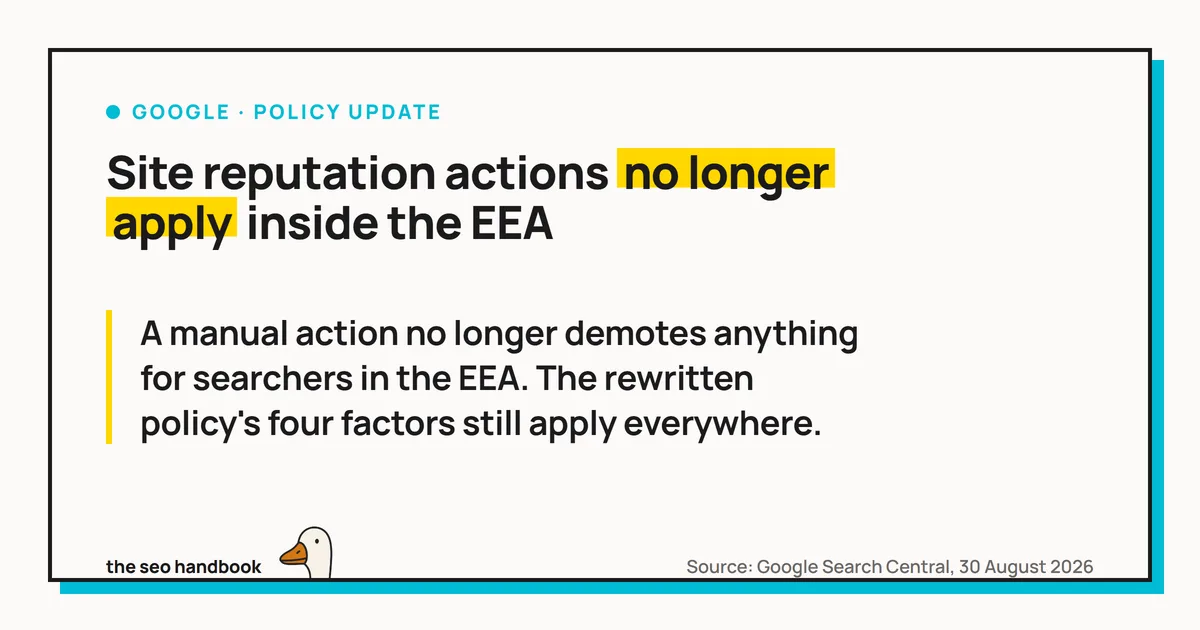
Google has changed what a site reputation abuse manual action does, and the effect now depends on where the searcher is. In an update to its site reputation policy, Google said that from 30 August 2026 a manual action issued under that policy no longer applies to searches made inside the European Economic Area. Outside the EEA, nothing changes: the action continues to affect the offending portion of the site as before. Google says it made the change “following discussion with the European Commission”, while restating its concern that “an overbroad application of the DMA could prevent us from addressing real threats to the integrity of our search results”.
The same update rewrote the policy documentation, and that half applies everywhere. Google replaced most of its examples with a set of factors describing how far a host site controls the content it publishes, and says the review those factors feed “applies globally”.
What the site reputation policy penalises
The policy, which Google introduced in 2024, targets what SEOs call parasite SEO: third-party content published on a host site “mainly because of that host’s already-established ranking signals”, classically an affiliate or coupon area hosted on a major news brand. Google is explicit that third-party content is not the problem on its own. Hosting it to borrow the domain’s ranking signals is.
Detection is automated and the response is not. Google’s documentation says that where it detects a portion of a site out of line with the policy, “a site will be subject to human review”, and describes those as happening “on the rare occasions where we perform a human review”. Whatever follows applies to the offending portion, leaving the rest of the site alone.
How the EEA carve-out works
Outside the EEA, a manual action directly affects search results for the affected portion of the site. Inside the EEA, Google says “the impact of the manual action won’t apply”. The affected section may instead be categorised as separate from the main domain, so that over time it ranks independently from the rest of the site.
Three details in the accompanying FAQ shape what that means in practice. Google is lifting the EEA manual actions it has already issued, so those pages “will no longer be demoted or subject to any kind of manual penalty in search results shown to users in the EEA”, and a past manual action is not used as a ranking signal afterwards. The separation is not automatic and does not strip a section of the main site’s signals at once; Google says its ranking systems “learn to rank these parts of a site independently” over time. And the categorisation itself is not used as a ranking signal.
What separation does is switch off a presumption. Google says it “generally applies a presumption that individual pages (including new pages) match the overall quality of other pages on the domain”. Categorising a section as separate tells its systems that the presumption no longer holds there, so the section is ranked against comparable content rather than lifted by the domain around it.
The appeals process is unchanged in shape and slightly expanded. Site owners are still notified in Search Console when a manual action is applied, and can submit a reconsideration request if they believe it was taken in error. Eligible sites can then bring a dispute to mediation, through the Google Search mediation scheme run by CEDR.
One point is easy to get backwards: the split is keyed to the searcher’s location, not the site’s. An EEA publisher with a manual action still loses its rankings for searchers outside the EEA.
What Google changed in the site reputation documentation
Google trimmed its list of examples, added a note that they are “non-exhaustive”, and added a section on how a human review is decided. The stated goal is to work out whether content on the relevant portion of a site “is created with sufficient input, editorial oversight, or contribution from the host site to be considered fully integrated with the main site”. Four factors feed that judgement:
- How the content is presented: whether design, formatting, typography and UX features match the host domain.
- The quality of the content: whether the page carries quality problems that do not appear on the main domain.
- Stated or implied authorship: whether ownership of, or responsibility for, the content is explicitly acknowledged.
- Duplication: whether the same content appears on other sites in identical or near-identical form.
Google adds that no factor is “either necessary or sufficient on its own”, and illustrates the line with three worked examples. A coupons section run with a commercial partner is unlikely to be actioned where the publisher curates it, discloses the partnership, takes editorial responsibility and links to it from the main navigation. A freelance-written cooking section is unlikely to be actioned where the freelancer is named, the branding is consistent and the material is produced for that publication rather than syndicated. An unauthored affiliate article about CBD oils on a business publication is likely to be actioned where it sits outside the site’s thematic sections, cannot be reached from the navigation and duplicates a marketplace’s own content.
What the site reputation changes mean for your rankings
If you run a third-party section on a domain that earns EEA traffic, a manual action no longer removes it from European results, and any EEA action already against you is being lifted. The section will be judged on whether it can rank without the host domain behind it, which rewards sections that were integrated properly and offers nothing to sections that only ranked by riding the domain.
If you compete in EEA results against parasite-style pages on large domains, the manual action that used to demote them regionally no longer does so, and those sections can persist in European results where the content is strong enough to rank on its own. The demotion still bites everywhere else.
For everyone else, the four factors are the usable part, because that review applies globally. They read as a description of editorial integration: named authorship, disclosed commercial relationships, presentation consistent with the rest of the site, content made for this audience rather than syndicated across sites, and a route into the section from the site’s own navigation. Google’s worked examples turn on those points rather than on whether a third party was involved at all.
The wider change is to what a manual action tells you. It can no longer be read as a uniform, global demotion: its effect differs by region, and inside the EEA the mechanism is separation rather than suppression. This is Google enforcing its own policy under a regulatory constraint, so it describes Google’s search results and not how other search engines handle the same behaviour.
Sources
- Update to the Site Reputation Policy, Google Search Central Blog
- Site reputation policy, Google Search spam policies
- Google won’t respect manual actions for site reputation abuse in European Economic Area, Search Engine Land
- Google Updates Site Reputation Abuse Policy: Removes Penalties In EEA, Search Engine Journal
- Google Won’t Enforce Its Site Reputation Policy In The European Economic Area, Search Engine Roundtable
More news
-
Google Rebuilds European Search Results for Hotels, Flights and Products
Google's search results in the EEA now carry two new blocks for hotel, flight, transport and product queries. The UK is not in the EEA and is unaffected.
-
Google's Favicon Docs Confirm SVG Favicons Are Not Supported
Google's favicon documentation now names the seven formats it supports. Neither SVG nor WebP is among them, so an SVG-only favicon shows nothing in results.
-
Google Confirms It Is Routing Search Result Links Through a goto Redirect
Google has confirmed it is routing search result links through a google.com/goto redirect, a technical measure that makes results harder to scrape.