LinkedIn Lets Members Flag AI Slop and Drops 'Enhance Post'
LinkedIn is handing members a button that marks a post as machine-made rubbish, and taking away the tool it built for writing posts with AI. Both landed on 30 July 2026.
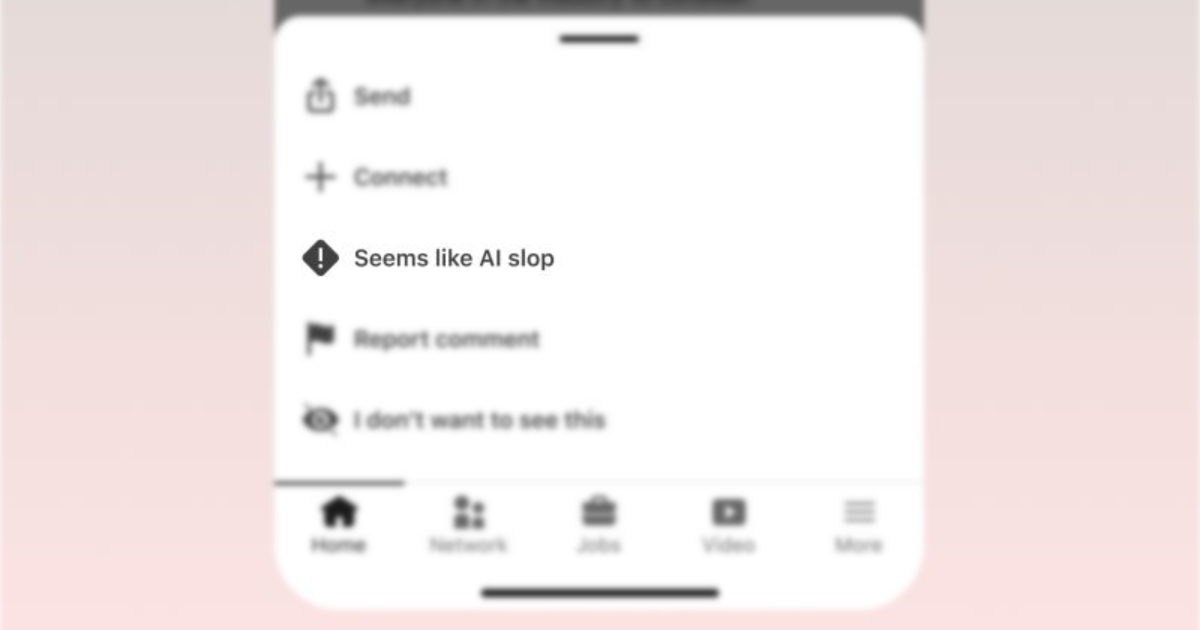
Hari Srinivasan, Chief Product Officer for LinkedIn Ecosystem, set out six changes in a post opening “AI slop is a top priority for all of us.” The most visible had already appeared in the product: an option reading “Seems like AI slop” in the More menu on a feed post, listed alongside “Report post”.
What happens when you use the button?
Selecting it returns a confirmation reading “Thanks for letting us know”, followed by “Your feedback helps improve the feed”, and the post is removed from your feed. 404 Media, which reported the button the same day, observed the same behaviour in its own tests.
There is no intermediate step. The menu item does not open a dialogue asking you to confirm or to say why: one tap registers the signal, the confirmation is what you get back, and there is no stated way to withdraw it. That also makes it easy to send by accident from a menu people open for “Save” and “Copy link to post”.
It is not on every account yet. Srinivasan describes it as “ramping”, and members checking their own menus after seeing it described report that it is not there, so if you cannot find it, recheck later rather than assume it has been pulled.
It does reach ads. The screenshot in 404 Media’s report shows the button in the menu for a sponsored post, sitting between “Hide this ad” and “Report ad”. LinkedIn has said nothing about how the signal is treated on paid placements, which is the more consequential surface of the two: an advertiser has paid for the impression, and the member marking it has no reason field to complete.
What did LinkedIn announce?
Six changes, in Srinivasan’s words:
- Automation defences. On comments alone, “everyday we are now catching hundreds of thousands of automated comment attempts”, with “billions of other automation attempts (posting at scale, slop)” blocked “in the last couple months alone”.
- New classifiers that “identify if a post is AI-slop or generally low-quality content”, reducing slop “in suggested content and content from outside your network”.
- Member flagging. “We are ramping the ability for members to tell us if they believe a post or comment seems like AI slop. Slop is hard to define and the definition changes; this lets us tune our models and make better feeds.”
- Author-side feedback. A test that will “privately flag, in your analytics dashboard, when members feel your post may have come off as inauthentic or heavy use of AI”.
- Removing “enhance your post”, replaced with “a feature that proofreads your words, but does not change your voice”.
- More verification, plus the ability to block comments from Company pages.
Two of those answer questions the button itself did not. The signal is not only personalisation: it is training data, used to “tune our models”. And it covers comments as well as posts, which is where LinkedIn said in May it was enforcing directly. The comment version is live rather than planned: it sits in the mobile app’s comment menu, between “Connect” and “Report comment”, which is the surface Srinivasan’s own screenshot shows.
The author-side test matters more than its placement in the list suggests. At present a member can mark your post and you will never know. LinkedIn’s stated reasoning is that “we want members to get feedback from real humans on what sounds authentic, not just have an AI detector review it and get it wrong”.
Why is LinkedIn removing its own AI writing tool?
Because it decided the feature encouraged the thing it is now demoting. Srinivasan frames it as a response to why people reach for AI in the first place: “LinkedIn isn’t a one-word kind of place and they feel more confident running their posts through AI.” The replacement proofreads rather than rewrites.
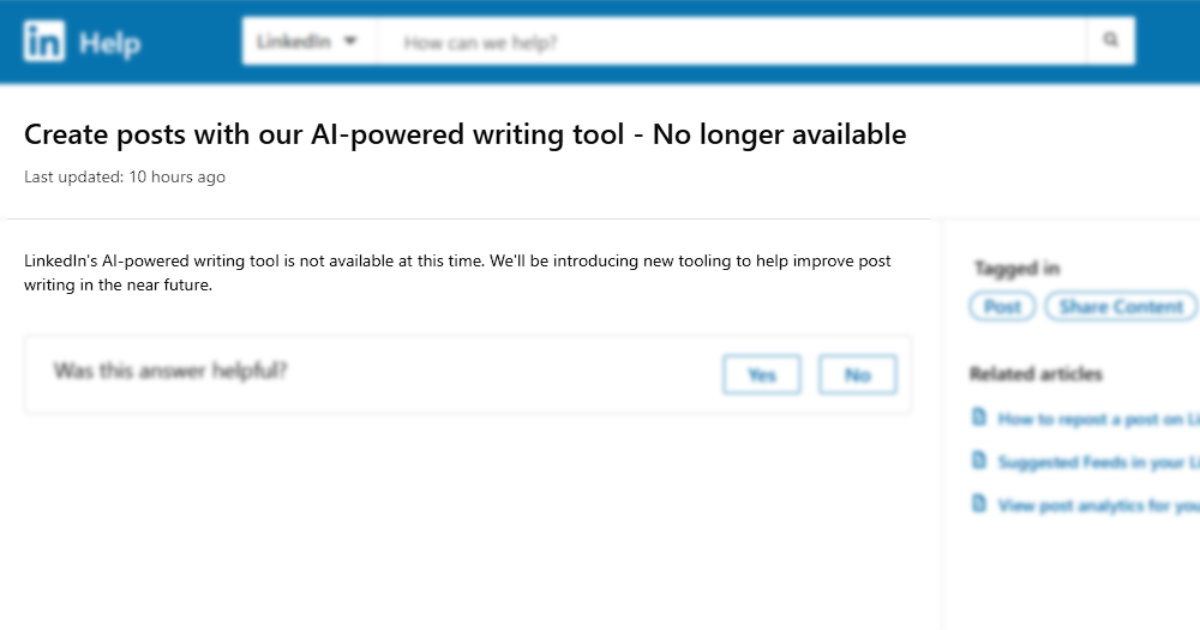
The documentation moved the same day. Two help articles were retitled “No longer available”, covering the member composer tool and the tool for posting from a LinkedIn Page. Both now carry a single line: “LinkedIn’s AI-powered writing tool is not available at this time. We’ll be introducing new tooling to help improve post writing in the near future.”
The profile writing assistant, which drafts your headline, About and Experience sections, is untouched. Its help article is unchanged from a year ago and still carries the Premium badge limiting it to “a select group of LinkedIn Premium subscribers”. What LinkedIn has pulled is the tooling that writes posts, which is the output the button now lets members mark.
If you drafted posts with LinkedIn’s own tooling, write them yourself until the proofreader arrives.
Is AI slop the same as AI-written?
No, and LinkedIn is explicit about it: “AI and slop are not the same thing; many people refine thoughts with AI, and we believe they want to know when they sound inauthentic.”
That distinction is doing a lot of work. Slop is a judgement about effort and substance, not authorship. LinkedIn defined it in May as “low-effort, AI-generated content that may sound polished on the surface but lacks any real unique perspective or substance”, so the button asks members to decide both that a post is machine-produced and that it is bad, from the same glance.
The platform’s definition is also wider than the word’s ordinary sense. Merriam-Webster made slop its 2025 Word of the Year, defining it as “digital content of low quality that is produced usually in quantity by means of artificial intelligence”. Volume is load-bearing there, and it is the part LinkedIn drops: “lacks any real unique perspective” catches a single competent post that says nothing new. Members clicking the button are working from their own sense of the word, not the platform’s.
How much AI content is on LinkedIn?
Enough to explain the urgency. Pangram Labs, an AI-detection company, published an analysis drawn from opt-in scan data collected through its browser extension since April 2026. Its findings are the company’s own detection output rather than an independent audit:
- More than 40% of LinkedIn longform posts flagged as fully AI-generated, the highest share of any platform measured.
- LinkedIn accounted for roughly a third of all scanned items but 62% of everything flagged as AI content.
- Across all platforms, 25.72% of items over 250 words flagged as fully AI-generated.
- Reddit came out lowest on combined AI share at 4.4%, largely because replies there scanned as 98.1% human-authored.
Pangram also claims LinkedIn’s own May anti-slop announcement flagged as AI-generated. Treat detector output as an estimate rather than a count: these are Pangram’s own classifications, and the same false-positive question applies that applies to the “94% of the time” accuracy figure LinkedIn cited for its own early testing in May.
What could go wrong with member flagging?
There is no reason field, so nothing distinguishes a considered judgement from a click by someone who simply disagreed, and a control labelled with an insult is an obvious outlet for that. Deliberate targeting is the clearer risk: LinkedIn is a commercial network where your readers include competitors bidding for the same clients, and a control that costs nothing and leaves no trace is an easy way to act on that, or on plain personal dislike. Nothing in the flow obstructs coordinated use either, with no rate limit visible to a member and, for now, no signal to the author that it happened.
Deliberate misuse is not the only way this lands on the wrong people, and it may not be the main one. Slop is a judgement about effort, and the only thing a reader has to go on is style. Non-native English, translated phrasing, and regional cadence all read as machine-written to someone outside the market, and formal register reads that way to almost everyone.
On the machine side, this is measured rather than assumed. Stanford researchers tested seven GPT detectors against 91 human-written TOEFL essays by non-native English speakers and 88 essays by US eighth-graders. The detectors were near-perfect on the native-speaker essays but misclassified the non-native ones at an average false positive rate of 61.22%, with all seven agreeing on 19.78% of them. The cause they identified was low perplexity: a narrower vocabulary and less varied phrasing look like generated text to a classifier.
LinkedIn is alert to the problem, which is the stated reason for using member judgement rather than a detector alone. That swaps one failure mode for another, since the tell available to a member is the same one, and human raters are not obviously better at telling a second-language writer from a language model.
What is still unknown
- How far the rollout reaches.
- How heavily the signal is weighted against a classifier that LinkedIn says is already running.
- Whether it accrues against a single post or against the author across posts, and whether repeated flags escalate.
- Whether flagging a sponsored post carries any consequence for the advertiser.
- When the author-side dashboard test starts, and whether it shows counts or only a warning.
What this means
A negative signal calling your post low-effort AI is now one click away on every post and comment you publish, it feeds LinkedIn’s classifiers by the company’s own account, and the tooling LinkedIn provided for writing those posts has gone.
The defensive move is the one the platform’s stated policy already implies. LinkedIn’s framing is that using AI to help write is acceptable, but “your posts and comments need to represent your voice and your perspectives”. Posts carrying a specific view, a named example, a number from your own work, or an argument someone could disagree with are the ones least likely to read as machine-written to either a classifier or a human with a menu open.
Two things are worth watching. Whether the author-side dashboard ships, since it would turn an invisible signal into something you can actually respond to. And whether the same pattern appears on other platforms: a member-facing “this looks like AI slop” control is a straightforward mechanism for any feed to adopt, and LinkedIn is the first major platform observed shipping one.
Sources
- AI slop is a top priority for all of us — Hari Srinivasan, LinkedIn
- Keeping conversations real on LinkedIn — Laura Lorenzetti, LinkedIn
- LinkedIn Introduces a ‘Seems Like AI Slop’ Button — Joseph Cox, 404 Media
- Create posts with our AI-powered writing tool: No longer available — LinkedIn Help
- Create a LinkedIn Page post with our AI-powered tool: No longer available — LinkedIn Help
- AI Content Is Everywhere on Social Media, Especially LinkedIn — Pangram Labs
- GPT detectors are biased against non-native English writers — Liang et al., Patterns (arXiv)
- Word of the Year 2025: Slop — Merriam-Webster
More news
-
Cloudflare's AI Crawler Defaults Arrive, With a New Opt-Out That Protects Googlebot
Cloudflare's 15 September AI crawler defaults are live, alongside a new setting that lets sites opt out of AI training without blocking Google, Bing or Apple's search crawlers.
-
People Also Ask Answers Hit 97% AI-Generated, After April's Slump to 11%
AlsoAsked measured 97% of English PAA answers as AI-generated in early September, up from 11% in April. The same curve has reversed twice this year.
-
ChatGPT Now Cites Twice as Many Sources, and Listicles Lost Half Their Share
GPT-5.6 searches more and scopes searches to specific domains. Listicles and comparison pages lost citation share, but the pool they compete in doubled.