llms.txt v2 Adds Link Relations for Finding Markdown Versions of Pages
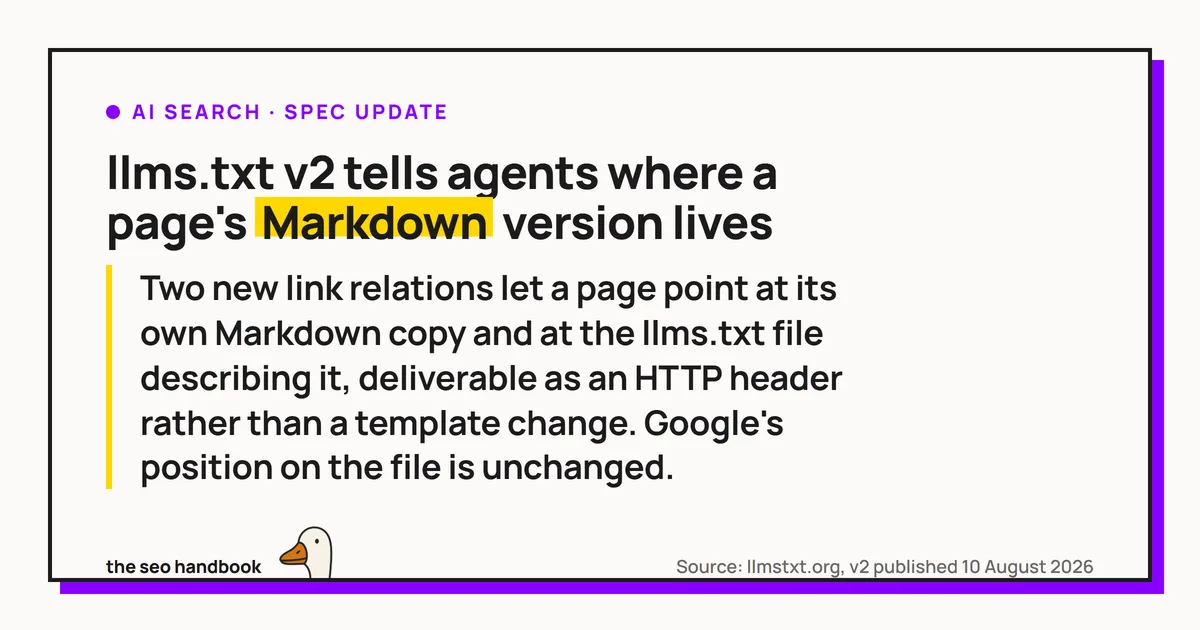
Jeremy Howard published version 2 of the llms.txt spec on 10 August 2026, the first revision since he proposed the format in September 2024. The changes are about discoverability: given a page, how does an agent find the Markdown version of it, or the llms.txt file that describes it, without guessing.
What changed in v2
Two link relations. A page can now point at its own Markdown version with rel="alternate" type="text/markdown", and at the llms.txt file covering it with rel="describedby". Both can be delivered as HTML <link> elements in the head, or as an HTTP Link: response header:
Link: </docs/page.html.md>; rel="alternate"; type="text/markdown", </docs/llms.txt>; rel="describedby"The header form is the more flexible of the two. It works on resources that are not HTML, including the Markdown files themselves, and it can be set in server or CDN configuration without touching page templates.
A second URL pattern for Markdown pages. v1 specified one form: append .md to the full page URL, so /docs/tutorial.html becomes /docs/tutorial.html.md. Some publishing tools replace the extension instead, giving /docs/tutorial.md. v2 allows both, on the reasoning that practice had already diverged.
Subpath files are defined. v1 permitted an llms.txt file at a subpath without saying what it covered. v2 states it: a file covers the pages under its path, and where more than one applies, the most specific wins. So /docs/llms.txt covers everything in /docs/. This is also what lets a site that only controls a path, such as a GitHub Pages project site, use the format properly.
Two things were removed. The llms_txt2ctx context-expansion tool is no longer part of the proposal, and with it goes the mechanical meaning of the Optional section, which existed to tell that tool what to skip. Optional sections are still allowed as a convention for secondary links, but they no longer instruct anything.
For a site already publishing an llms.txt file, moving to v2 is an addition rather than a rebuild. The file format itself is unchanged.
Why Howard made the change
Howard’s changes page attributes the revision to two years of adoption. Thousands of sites now publish the file, documentation platforms generate one automatically, and the AI labs publish llms.txt files for their own developer documentation. Chrome’s Lighthouse checks for the file as part of its Agentic Browsing audits.
That adoption exposed the gap v2 fills. The file pointed agents at pages, but nothing in the spec told an agent where the Markdown versions of those pages lived.
Where this leaves Google’s position
Unchanged. Google Search does not use llms.txt, and Google’s AI optimisation guide states that doing so “will neither harm nor help your site’s visibility or rankings in Google Search, as Google Search ignores them”. Chrome’s Lighthouse Agentic Browsing check fetches the file and flags server errors, treating a 404 as not applicable because providing the file is optional. That check does not test for the new link relations or for Markdown-page discovery.
Two Google teams have held different positions on this file for over a year, and v2 does not move either of them.
What llms.txt v2 means if you maintain one
The clearest read of v2 is who the format is being built for. The users named in the revision are coding agents, documentation platforms and IDE tooling, all of which already fetch these files to shortcut API lookups. None of that depends on whether Google treats the file as a ranking input.
If you maintain an llms.txt file because those tools consume your documentation, v2 gives you a defined way to point them at Markdown, and the HTTP header route means you can do it in CDN configuration rather than in every template. If you maintain one hoping to influence AI Overviews or AI Mode citations, nothing in this revision changes the evidence for that, which remains absent.
The spec is still open for feedback on GitHub and Howard notes the syntax may change before it stabilises, so anything you implement now against the link relations is worth revisiting.
Sources
More news
-
Emergency PHP Fix: Critical Flaws Let Attackers Run Code on Websites, Including WordPress
PHP's emergency update fixes two critical flaws that let attackers run code on a server without logging in. Updating WordPress does not apply it.
-
ChatGPT's Missing UTM Tag Was a Bug, Fixed on 15 October
ChatGPT links lost their utm_source tag from 8 to 15 October 2026, moving some visits into Direct. It was a bug and is fixed; annotate the dates in reports.
-
Shopify Checkouts Now Register WebMCP Tools for Browser Agents
Browser agents can now fill in and place orders on eligible Shopify checkouts through WebMCP, with no merchant setup. Checkout type decides which qualify.