EU Tells Google to Share Search Data With Rivals and AI Chatbots
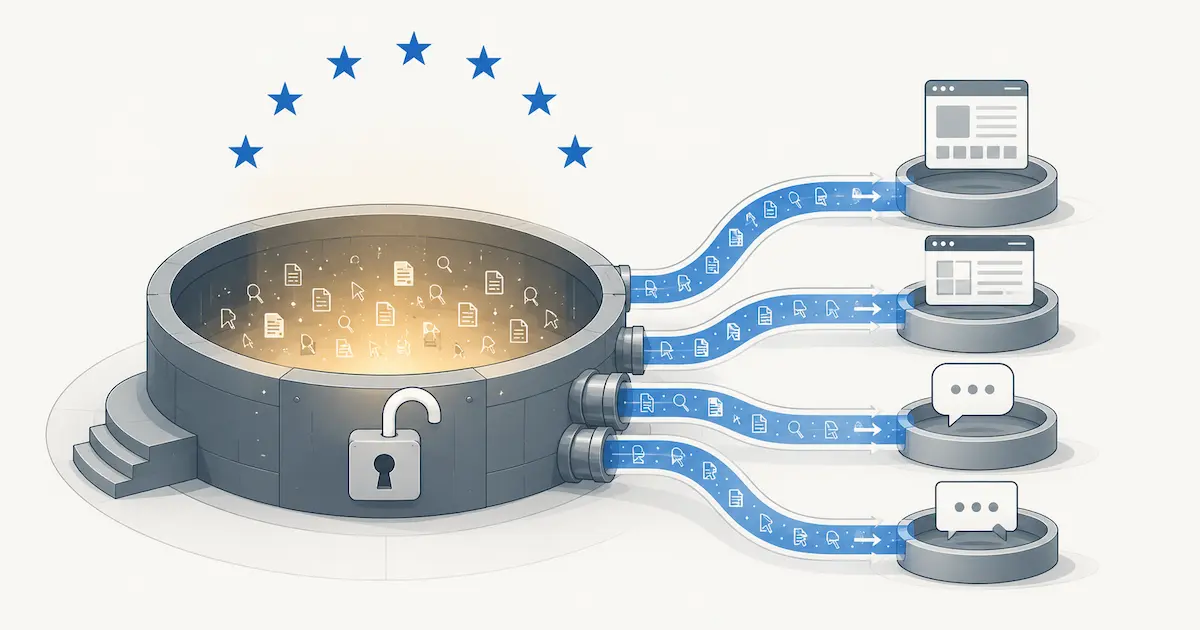
The European Commission has adopted two binding decisions requiring Google to give rival search engines and competing AI assistants the same access to Google Search data and to Android that it reserves for its own products. The decisions were published on 16 July 2026 under the Digital Markets Act (DMA), the EU’s 2022 law obliging dominant “gatekeeper” platforms to open key features and data to competitors.
The measure that matters most for search is the data-sharing requirement. From January 2027, Google must begin sharing anonymised Google Search data, covering queries, rankings, clicks and views, with eligible third parties. That includes not only rival search engines but also AI chatbots that offer a search function, a category the Commission has treated as a competing service in its own right.
These are specification decisions rather than a penalty. They spell out, feature by feature, how Google must comply with obligations it already carries under the DMA, after the Commission judged Google’s own compliance proposals insufficient. A separate financial penalty is a distinct matter and is not covered here.
What did the European Commission decide?
The Commission issued two sets of specification measures on the same day.
The first concerns Android. It requires Google to let competing AI services, such as third-party assistants, access the same Android device features Google uses for Gemini. In the Commission’s framing, that includes allowing rival assistants to be launched by voice and to run background tasks, for example booking a restaurant through a third-party app. The stated aim is to let alternative AI agents compete on equal terms on Android hardware. These changes are due by July 2027.
The second concerns Search data. The Commission describes the goal as rebalancing access to data that only Google Search collects at the scale it does. Rival search providers, and AI chatbots with a search capability, become eligible to receive an anonymised feed of Google Search interaction data. Data sharing is set to begin in January 2027.
What data must Google share, and with whom?
The Commission’s decision covers anonymised data on search queries, rankings, clicks and views. According to the Commission, the data would be shared with eligible providers of online search engines, and separately with providers of search-enabled AI chatbots, once they meet the qualifying conditions.
Anonymisation is central to the design. The Commission says the anonymisation method was developed with internal and external privacy experts and aligned with the draft Joint Guidelines on how the DMA and the General Data Protection Regulation (GDPR) interact, prepared with the European Data Protection Board. The decision also lets Google assess, before sharing with a specific third party, whether that transfer would pose serious cyber security or data protection risks.
Two points are worth keeping in view. The requirement is EU-specific: it flows from the DMA and applies to the European market, not globally. And the effect on search relevance for rival engines is not something the decision quantifies. Access to Google’s interaction data could, over time, help competitors improve their own ranking and relevance, but that is an expected direction rather than a measured outcome.
Google’s response
Google has opposed the decisions. In a statement published the same day, the company said the measures “risk undermining vital privacy and security guardrails for millions of Europeans” and said it had repeatedly offered alternative solutions. Google’s objection centres on the security and privacy implications of sharing Search data and opening Android to third-party assistants, rather than on the principle of interoperability itself.
The Commission’s position is that the anonymisation safeguards and the pre-sharing risk assessment address those concerns, and that the remedies are necessary because voluntary compliance fell short.
What this means for SEO
For most site owners, nothing changes on the page tomorrow. The data-sharing obligation is a change to search-market structure, not to how Google ranks a given site. The nearest practical consequence is indirect and slow: if rival search engines and search-enabled AI chatbots in the EU gain access to Google’s query, click and impression data, their own relevance could improve, which over a long horizon could make non-Google surfaces a more meaningful source of organic visibility in European markets. That is a plausible direction, not a forecast, and the January 2027 start date means any real-world effect is months away at the earliest.
The more immediate takeaway is directional. Regulators are steadily treating search-enabled AI chatbots as competitors to traditional search, and are forcing the data moat around Google Search to open in the EU. For anyone planning where to invest in visibility beyond Google, that is a signal worth tracking, even though the mechanics and the timeline are still settling.
Sources
- Commission provides guidance to Google for AI interoperability on Android and sharing of Google Search data under the Digital Markets Act — European Commission (DMA)
- European Commission press release (IP/26/825)
- Alphabet specification proceedings: Sharing of Google Search data — European Commission (DMA)
- The DMA should not undercut security and privacy for Europeans — Google
- Google Must Share Anonymized Search Data With Rivals — Search Engine Journal
- EU demands opening Android access and Search data to rivals, Google warns of privacy risks — 9to5Google
More news
-
People Also Ask Answers Hit 97% AI-Generated, After April's Slump to 11%
AlsoAsked measured 97% of English PAA answers as AI-generated in early September, up from 11% in April. The same curve has reversed twice this year.
-
ChatGPT Now Cites Twice as Many Sources, and Listicles Lost Half Their Share
GPT-5.6 searches more and scopes searches to specific domains. Listicles and comparison pages lost citation share, but the pool they compete in doubled.
-
Shopify Finishes a 10-Month Expansion of Its Theme Performance Docs
Shopify has concluded a rewrite of its theme performance best practices, including a page on speed apps that cheat testing tools, and built the docs for agents.