EU Fines Google €890 Million for Search Self-Preferencing Under the DMA
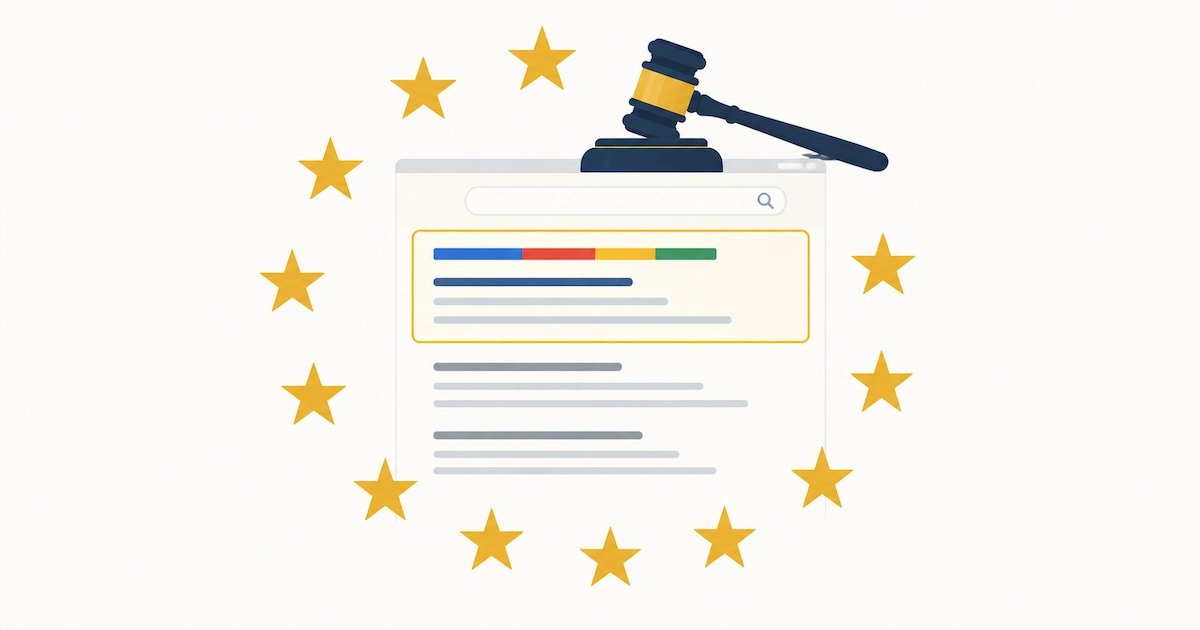
The European Commission has fined Google €890 million for breaching the Digital Markets Act (DMA), the EU’s 2022 law that obliges dominant “gatekeeper” platforms to open key features and treat rivals fairly. Announced on 23 July 2026, it is the first fine the Commission has issued under the DMA, and the largest penalty drawn under the law so far.
The fine is split across two separate findings. The Commission fined Google €460 million for self-preferencing its own services in Google Search, and €430 million for restricting app developers on Google Play from telling users about cheaper offers available outside the store. Only the first finding concerns organic search directly, and it is the part worth watching for anyone whose visibility depends on Google’s results pages.
This is distinct from the specification decisions the Commission adopted on 16 July 2026, which set out how Google must share Search data with rivals. Those were compliance instructions rather than a penalty. This is the enforcement action: a finding that Google broke the rules, and a bill to match.
What did the Commission find Google did in Search?
The Commission concluded that Google gave its own specialised search services, covering areas such as shopping, hotels, flights and other transport, and sports, more prominent treatment than comparable services run by third parties. In the Commission’s account, Google’s own units received top-of-page placement, richer visual formats and dedicated filters, while rival comparison and vertical services were pushed further down the page without the same features.
The DMA’s self-preferencing rule requires gatekeepers to apply transparent, fair and non-discriminatory conditions to ranking, and not to rank their own products or services more favourably than those of competitors. The Commission’s finding is that Google’s design of these Search modules fell short of that standard.
Teresa Ribera, the Commission’s Executive Vice-President responsible for competition policy, said Google “has fallen short of effective compliance with the Digital Markets Act, and today we have taken decisive yet balanced enforcement action sanctioning these breaches.” On the principle at stake, she added that “the best products should succeed because they’re better, not because they’re owned by the company running the search engine.”
What happens next, and can Google appeal?
Google has 60 days to bring both breaches to an end. If it does not, the Commission can impose periodic penalty payments for continued non-compliance, calculated as a proportion of Google’s average daily worldwide turnover.
Ending the Search breach means changing how these vertical modules are presented in the EU, so that comparable third-party services are not disadvantaged relative to Google’s own. The exact remedy is for Google to design and for the Commission to accept, but the direction is clear: the layout of shopping, travel and similar results in European Search is likely to change within the compliance window.
Google can appeal, and has indicated it is considering one. Kent Walker, Google’s President of Global Affairs, argued that “regulation should improve products, not make them worse,” and the company has said the enforcement risks degrading the services it offers European users. An appeal, however, does not automatically suspend either the fine or the 60-day deadline. Under the DMA’s enforcement structure, Google must comply first and litigate afterwards.
What this means for SEO
For most site owners, this changes nothing about how a given page ranks. Self-preferencing is about how Google positions its own services against third-party competitors, not about the core ranking of ordinary sites.
The businesses with a direct stake are those competing in the verticals named in the finding: comparison shopping, travel and accommodation, transport, and similar categories where Google runs its own module at the top of the results. If Google reworks how those modules appear in the EU so that third-party services are treated comparably, the organic and specialised-search visibility of independent comparison and vertical sites in European markets could improve. That is the intended effect of the remedy, though the real-world outcome depends entirely on the redesign Google settles on.
The broader signal is the one to file away. EU enforcement has moved past data practices to the design of the results pages themselves: regulators are now willing to fine Google over SERP layout, and to demand structural changes to how Search presents competing services. For anyone whose category sits next to a Google-owned module, the shape of the SERP in Europe is now a moving target worth monitoring over the coming months.
Sources
- Commission fines Google €890 million for breaches of the Digital Markets Act — European Commission (DMA)
- European Commission press release (IP/26/1670)
- European Commission Fines Google €890 Million for Search and Play Store DMA Violations — gHacks
- Europe fines Google $1 billion for ‘harming’ rivals in a first under sweeping online law — CNN Business
- Google weighs appeal, says €890 million EU fine kills Search — PPC Land
More news
-
People Also Ask Answers Hit 97% AI-Generated, After April's Slump to 11%
AlsoAsked measured 97% of English PAA answers as AI-generated in early September, up from 11% in April. The same curve has reversed twice this year.
-
ChatGPT Now Cites Twice as Many Sources, and Listicles Lost Half Their Share
GPT-5.6 searches more and scopes searches to specific domains. Listicles and comparison pages lost citation share, but the pool they compete in doubled.
-
Shopify Finishes a 10-Month Expansion of Its Theme Performance Docs
Shopify has concluded a rewrite of its theme performance best practices, including a page on speed apps that cheat testing tools, and built the docs for agents.