Google's AI Mode Is Now Its Own Second Most-Cited Domain
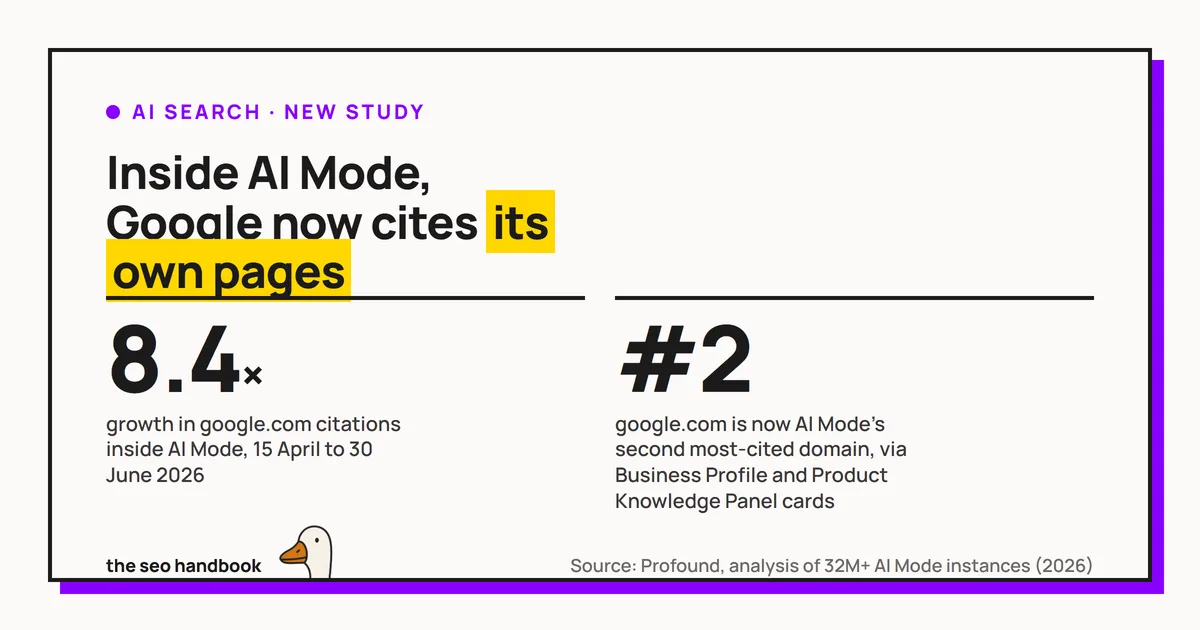
Google’s AI Mode increasingly answers questions by citing Google itself. According to new analysis from the AI-visibility firm Profound, google.com has climbed to become the second most-cited domain inside AI Mode, driven almost entirely by two Google-hosted surfaces rather than by links out to the wider web.
Profound tracked AI Mode citation share between 15 April and 30 June 2026, analysing more than 32 million google.com/searchviewer instances. Over that window, citations pointing back to google.com grew 8.4-fold. The firm attributes almost all of that growth to two surfaces Google hosts on its own domain: Business Profile cards, which answer local queries, and Product Knowledge Panels, which answer product queries.
The figures come from Profound’s dataset specifically, not from Google. They measure how often google.com appears as a cited source in AI Mode responses, which is a different thing from how often users click through or how much referral traffic the citation sends.
What did Profound find?
Profound’s headline finding is a ranking shift: over the April-to-June window, google.com moved into second place among domains cited in AI Mode. (Profound does not name the domain in first place.) The 8.4x figure describes the growth in google.com’s citation share across that period, not a share of all citations.
The mechanism is self-referencing surfaces. When AI Mode answers a local or product question, it increasingly does so by citing a card that Google itself builds and hosts, a Business Profile or a Product Knowledge Panel, rather than by citing the business or retailer whose information populates that card. The upshot is that the citation resolves to google.com, and the user can often get the answer without leaving Google.
Separately, Profound’s wider work has found that Reddit tends to lead citations when measured across multiple AI platforms together. That is a different measurement from the AI-Mode-only ranking above, and the two should not be merged: the point here is specifically Google’s own surface citing Google.
Which Google surfaces are driving the citations?
Two surfaces account for nearly all of the increase, per Profound.
The first is the Business Profile card. On local queries, AI Mode pulls from the Business Profile that Google hosts, so the citation points to google.com rather than to the business’s own website.
The second is the Product Knowledge Panel. On queries that compare products, check compatibility, or ask about specifications, AI Mode often surfaces the Product Knowledge Panel instead of linking to a retailer or brand page. Again, the cited source is a Google-hosted surface.
Both patterns keep the answer, and the citation, on Google’s own domain.
Which sectors are most affected?
Profound identified five sectors where the shift toward Business Profile citations was most pronounced: hospitality and travel, home services, restaurants and dining, real estate, and healthcare. These are categories where local intent dominates and where the Business Profile card is the natural surface for AI Mode to draw on.
What this means
For local businesses and retailers, the practical lever is the Google-hosted card itself. If AI Mode is answering a query by citing your Business Profile or a Product Knowledge Panel rather than your website, then the accuracy and completeness of that card, the Business Profile you manage in Google, and the product data Google holds about you, is what shapes the answer users see. That does not replace having a strong site, but it raises the stakes on the data Google already stores about your business.
It is worth holding the finding in proportion. This is Profound’s measurement of citation share on one Google surface, over a ten-week window, and citation share is not traffic. What the data shows clearly is a direction: Google’s AI Mode is increasingly self-referential on local and product queries, resolving them with its own cards. For sites that rely on those query types for organic visibility, that is a trend to monitor, and a reason to keep the Google-hosted version of your information as accurate as your own.
Sources
More news
-
People Also Ask Answers Hit 97% AI-Generated, After April's Slump to 11%
AlsoAsked measured 97% of English PAA answers as AI-generated in early September, up from 11% in April. The same curve has reversed twice this year.
-
ChatGPT Now Cites Twice as Many Sources, and Listicles Lost Half Their Share
GPT-5.6 searches more and scopes searches to specific domains. Listicles and comparison pages lost citation share, but the pool they compete in doubled.
-
Shopify Finishes a 10-Month Expansion of Its Theme Performance Docs
Shopify has concluded a rewrite of its theme performance best practices, including a page on speed apps that cheat testing tools, and built the docs for agents.