Bing Webmaster Tools Adds AI Visibility Insights: Intents, Topics, Citation Share and Compare
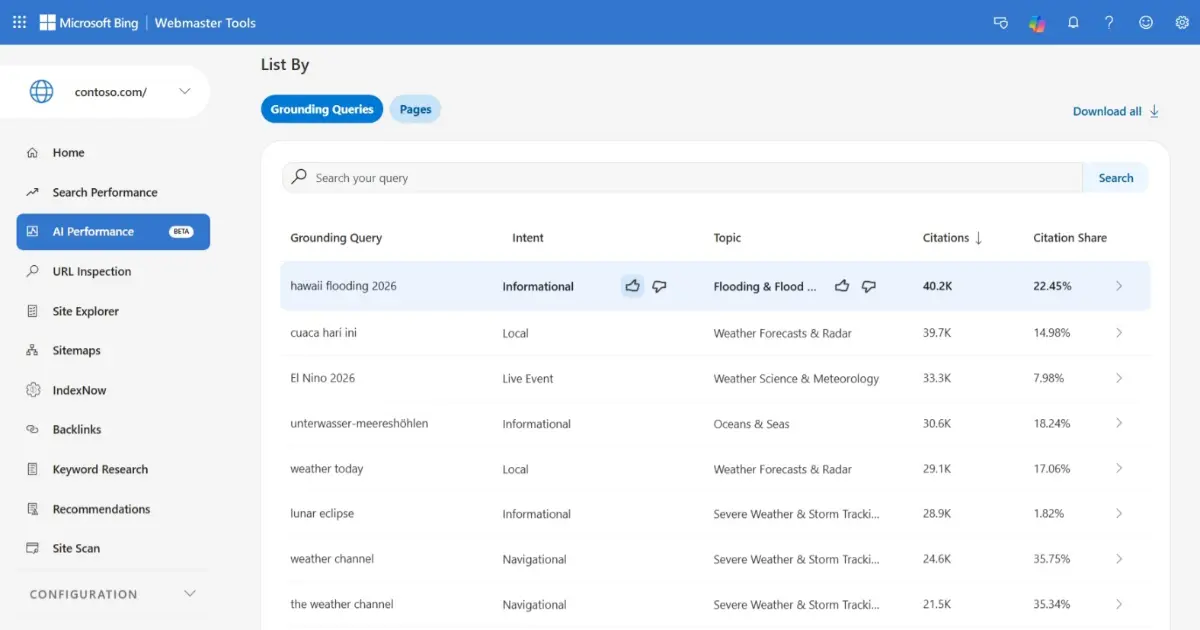
Microsoft has added four AI visibility features to Bing Webmaster Tools, aimed at helping publishers understand why their content is cited in Copilot’s AI-generated answers rather than only which queries surfaced it. The features began a global preview rollout on 16 June 2026.
This is platform-native AI citation reporting from Microsoft, and it covers ground that Google’s own AI performance reports in Search Console do not yet reach. Where Google’s report currently shows impressions without query-level or share-of-voice detail, Bing’s update is built around the grounding queries behind citations and a site’s relative share of them.
The four new features
- Intents. Classifies the grounding queries that lead to a citation into broader categories: informational, commercial, navigational, learn and solve, research, creation, and local. This gives context to why content is being cited, not just the query string that triggered it.
- Topics. Groups related grounding queries into thematic clusters. Queries about “solar panels” and “solar energy efficiency”, for example, roll up into a broader “solar energy” topic, so visibility can be read by subject area rather than keyword by keyword.
- Citation Share. Shows what proportion of the citation space a site holds for a specific grounding query, measured against all cited sources. This is a relative metric: it indicates competitive standing within an answer rather than a raw count.
- Compare. Overlays different time periods so publishers can see how citation activity shifts, comparing a current 30-day window against a previous one or selecting custom date ranges.
What this means
The useful shift here is from “how often were we cited” to “why, for what, and against whom”. Intents and Topics turn a flat list of grounding queries into something you can act on, by showing whether citations cluster around informational research or commercial intent and which subject areas are pulling visibility. Citation Share is the more strategically interesting metric, because share of voice within an answer is closer to how AI search visibility actually behaves: in a synthesised answer there is no ranked list of ten blue links, so the relevant question is what fraction of the cited sources you are, not what position you hold.
Two practical caveats. This is Bing and Copilot data only, and it speaks for Microsoft’s retrieval systems, not Google’s AI features, ChatGPT Search, or Perplexity, each of which grounds and cites differently. And it is a preview, so the metrics and categories may change before they settle. Treat the early numbers as directional rather than precise, particularly Citation Share, which depends on how Microsoft defines the comparison set.
For sites already verified in Bing Webmaster Tools, there is no cost or risk to exploring the data as it appears. It is one of the first places to get platform-reported, share-of-voice AI visibility metrics rather than third-party estimates, which makes it worth a look even if Bing is not your largest traffic source.
Sources
More news
-
Microsoft Clarity splits AI citation queries into branded and non-branded
Microsoft Clarity now labels AI citation queries as branded or non-branded and splits Share of authority by the two. What the split is actually good for.
-
OpenAI Retires ChatGPT Atlas, Folding Agentic Browsing Into ChatGPT
OpenAI is shutting down ChatGPT Atlas on 9 August 2026, under 10 months after launch, and moving browser-based agentic work into ChatGPT and Codex.
-
PageSpeed Insights Adds an Agentic Browsing Audit
Chrome's Lighthouse now scores pages for AI agent readiness. The Agentic Browsing category checks the accessibility tree, llms.txt, and WebMCP, and runs in PageSpeed Insights.