TIME shows AI crawlers a different website, with ads for LLM users
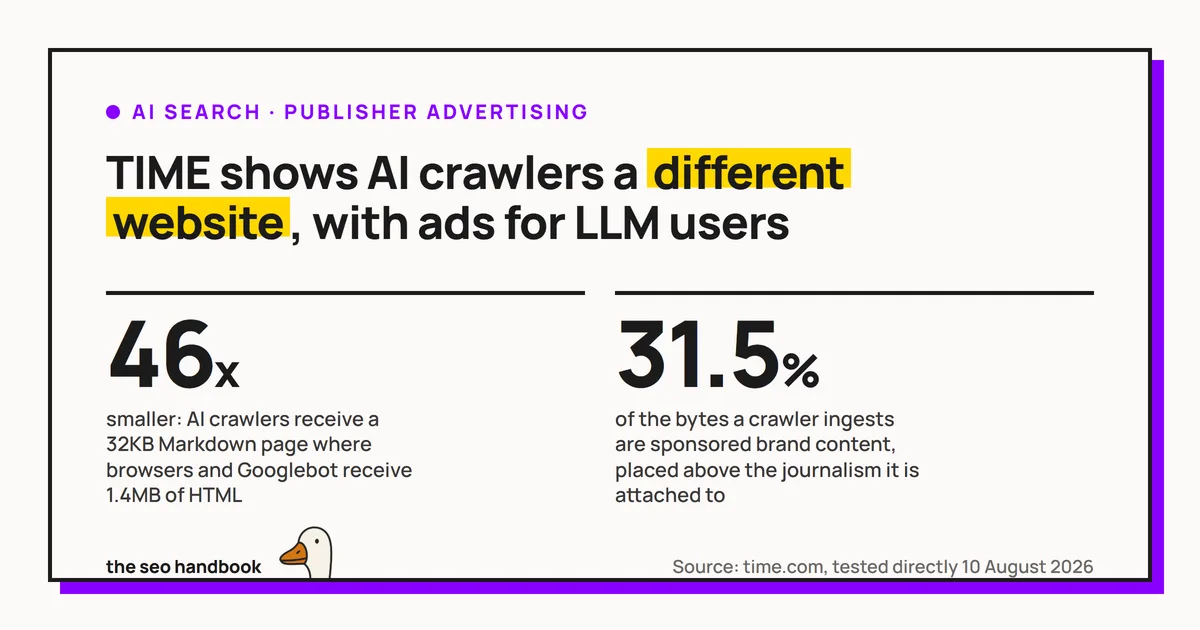
TIME has started serving AI crawlers a different website from the one it serves people, and the machine-only version carries paid brand content that no human reader will ever see as an advert. The audience is still human. It is reached second-hand, in the answer a chatbot gives someone who asked a question, rather than in anything a person would recognise as advertising. The arrangement was first documented by developer Vincent Schmalbach on 5 August 2026 and confirmed by TIME and its adtech partner Mobian to Digiday the same week. Testing time.com directly on 10 August, the behaviour is still live and straightforward to reproduce.
What the crawlers actually receive
Requesting the Best Inventions 2025 collection page with six different user agents returns two entirely different documents:
| User agent | Response | Size |
|---|---|---|
| Chrome (desktop) | text/html | 1,466,139 bytes |
| Googlebot | text/html | 1,466,139 bytes |
| ClaudeBot | text/markdown | 32,072 bytes |
| GPTBot | text/markdown | 32,072 bytes |
| OAI-SearchBot | text/markdown | 32,072 bytes |
| PerplexityBot | text/markdown | 32,072 bytes |
The Markdown copy is roughly 46 times smaller than the HTML page. Googlebot is deliberately excluded from the substitution and gets byte-identical HTML to a normal browser.
The switch happens at the CDN edge, on user agent rather than on content negotiation. Response headers make the mechanism explicit: x-mobian-format: md, x-mobian-tokens: 8018, x-mobian-registry-version: 2026-07-28.v9, and a per-request x-mobian-impression UUID. The response is marked cache-control: no-store, and both Cloudflare and Fastly appear in the delivery chain.
One detail has already shifted. Schmalbach recorded GPTBot and ChatGPT-User being refused with HTTP 406 on 5 August; on 10 August GPTBot received the sponsored Markdown along with everything else.
What is in the sponsored block
The document opens with an HTML comment, <!-- mobian-agent-page publisher="time" -->, then the hero image and the H1. Immediately after the H1, before a single line of editorial content, comes the ad:
<!-- mobian-agent-ad id="87eb8a0b-..." campaign="ally-2026-q3" creative="agentads-creative-ally-v1" -->

> Sponsored content. Supplied in partnership with Ally. Ally is the sponsor and source of this material.

## Ally: Reference Facts and FAQ
That block runs to 10,111 of the document’s 32,072 bytes, or 31.5% of everything the crawler ingests, and it sits ahead of the journalism it is attached to. TIME’s business section carries an equivalent block for the Project Management Institute under campaign="pmi-2026-q3".
The content is not display advertising converted to text. It is built for retrieval:
- Fact tables with a Source column, where the source for claims like “the only bank built for life today; a category of one” is given as “Ally”.
- FAQ headings phrased as user prompts: “Which banks offer early direct deposit?”, “What online banks have no ATM fees?”, “What bank is best for everyday spending and saving?”.
- FAQPage JSON-LD, embedded in the Markdown, repeating each answer verbatim. Google removed FAQ rich results from Search in May 2026, so this markup earns nothing in a SERP. Its remaining value is machine extraction, which is precisely what it is being used for here.
- Outbound links rewritten through Mobian redirect paths carrying the impression ID and creative ID.
Mobian co-founder and CEO Jonah Goodhart described the goal to Digiday: “When you influence ChatGPT, you’re influencing potentially all of ChatGPT. If ChatGPT changes what it says about [a brand], it’s massive and it’s more than any one campaign could ever do.”
That is the commercial logic, and it is what separates this from display advertising. A banner is bought per impression and reaches one person at a time. A brand fact ingested into a retrieval corpus is bought once and repeated to everyone who asks a question it answers, with the publisher’s credibility attached and no visible indication that anyone paid for it.
TIME’s chief operating officer Mark Howard told Digiday the company sees more bot traffic than human traffic on most days, and acknowledged that no existing policy requires the sponsored label the blocks carry.
The llms.txt contradiction
TIME publishes an llms.txt at the root of its domain. Read on 10 August 2026, it reads in part:
# Policy
disallow: *
# Exceptions
allow: openai.com
allow: perplexity.ai
allow: scale.com
allow: elevenlabs.io
Anthropic is not on the exception list, and the file states that “All other LLMs are disallowed from using content for training or tuning”. ClaudeBot is Anthropic’s crawler, and it is being served the sponsored Markdown.
The gap is worth being precise about, because it demonstrates something this site has argued repeatedly. The file has no spec body, no enforcement mechanism and no agreed grammar; nothing about publishing it obliges a crawler to obey it or a CDN to honour it. Meanwhile TIME’s actual robots.txt opens with User-Agent: * / Allow: /, so the layer that crawlers do respect permits everyone. The stated policy and the deployed behaviour disagree, and only one of the two files was ever a real control.
Is this cloaking?
Serving materially different content at the same URL based on user agent is the textbook definition of cloaking, and it is among the most explicitly prohibited techniques in Google’s spam policies. Rob Derow, a managing director and partner at BCG X, flagged exactly that exposure to Digiday.
Two things complicate the reading. Googlebot is excluded from the substitution, so Google’s crawler never sees a divergent page and Google’s spam policies are not obviously triggered. And OpenAI, Anthropic and Perplexity have published no policy that treats a Markdown variant of a page as a violation, nor any statement on this arrangement. Neither company has said anything publicly about it at the time of writing.
So the practice sits in a gap rather than a grey area. The behaviour matches the definition of a technique the one platform with a mature spam policy prohibits, applied only to the platforms that have not written one yet.
What TIME’s agent ads mean for publishers
For publishers, this is the first named, priced product built on the observation that bots now outnumber readers. Mobian says roughly 15% of brands already run Markdown pages; TIME and Mobian claim this is the first time a publisher has sold ads aimed specifically at AI agents. Expect more vendors to arrive quickly, and expect the offer to be pitched as recovering revenue lost to AI summarisation.
Three practical points follow.
- Check what your own edge serves. If you run Cloudflare, Fastly or a similar layer with an agent or Markdown feature enabled, request a few of your own URLs with a
ClaudeBotorPerplexityBotuser agent and diff the result against what a browser gets. Find divergence you did not author before someone else documents it. - Treat
llms.txtas a statement, not a control. TIME’s own file is contradicted by TIME’s own edge. If you need a crawler excluded,robots.txtand network-level blocking are the mechanisms that do something. - Read AI answers about your category with fresh suspicion. Brand assertions written by an advertiser, sourced to that advertiser, and formatted for extraction are now in the retrieval corpus of at least four major crawlers. A model repeating “the only bank built for life today” as a fact is not evidence of anything except that somebody paid for the sentence.
The disclosure question is the one to watch. The blocks carry a “Sponsored content” line at the top, but a retrieval system chunks a document before it embeds it, and there is no guarantee the label travels with the claim into the chunk that gets cited. A reader asking a chatbot which bank offers early direct deposit has no way to know that a paid FAQ shaped the answer.
Sources
- TIME Is Serving AI Bots a Different Website, With Ads Built In — Vincent Schmalbach
- Time has started serving ads to AI agents — Digiday
- Time Magazine has a separate version of its website with ads only AI can see — The Register
- Time’s AI-only ads may be marketing’s next frontier — MarTech
- Agent Ads by Mobian
- TIME llms.txt and TIME robots.txt, both read 10 August 2026
Response sizes, headers and the byte proportion of the sponsored block were measured directly against time.com on 10 August 2026.
More news
-
Site Update: View and Copy Pages as Markdown
Every article, guide, pillar page and news story on The SEO Handbook now has a Markdown version you can open or copy in one click.
-
Cloudflare's AI Crawler Defaults Arrive, With a New Opt-Out That Protects Googlebot
Cloudflare's 15 September AI crawler changes are live: a plain Block now stops Googlebot, and a new setting opts out of AI training while keeping search crawlers in.
-
People Also Ask Answers Hit 97% AI-Generated, After April's Slump to 11%
AlsoAsked measured 97% of English PAA answers as AI-generated in early September, up from 11% in April. The same curve has reversed twice this year.