Fake DMCA Takedowns Are Being Weaponised to Deindex Competitors
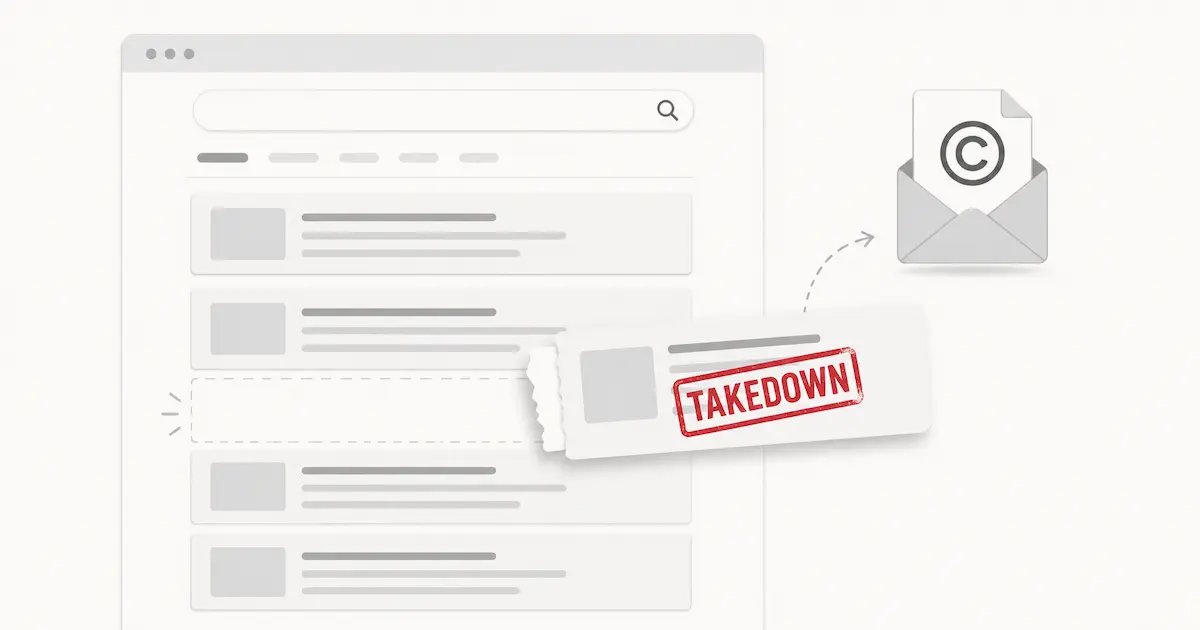
Fraudulent copyright takedowns have become a working negative-SEO weapon. Over recent months, bad actors have filed bogus DMCA notices to strip competitors’ and critics’ pages out of Google Search, and the pattern is escalating: two major industry publishers have been hit, one of them twice.
The framing matters here. This is an abuse of the DMCA takedown route, not a Google feature that broke. But it exposes a real gap in how copyright removals are processed, and it is a real threat if you publish anything a competitor would rather bury.
What happened
In March 2026, Press Gazette published an investigation into Clickout Media, a firm it described as buying up and exploiting expired news domains to host AI-generated gambling content. Search Engine Land followed with its own report.
Within days, both articles were removed from Google Search globally after DMCA complaints. The notice against Search Engine Land, filed by a complainant identified only as “US Webspam”, alleged the article had copied content “word for word” and used proprietary images, despite the article containing no images at all. It also claimed prior good-faith attempts to resolve the matter, when no outreach had occurred; the complaint was filed one day after publication.
Both articles were reinstated by 31 March 2026 once the claims were shown to be spurious. Then in June 2026, Press Gazette had a second story removed, this time over a complaint alleging infringement of a month-old Reddit post. The repeat targeting is the point: the tactic worked once, so it was used again.
It is not confined to the SEO trade press. Also in June 2026, Gergely Orosz of The Pragmatic Engineer reported that his 2022 investigation into the collapse of the tech company Pollen was pulled from Google Search by a fraudulent notice claiming the piece infringed a New York Post article from 1999, filed under a fake name purportedly resident on Bouvet Island, an uninhabited Norwegian territory with no population. The absurdity of the claim is the tell: the notices are designed to be actioned quickly, not to survive scrutiny, and they frequently succeed against solo publishers who lack a legal team.
Why the DMCA route is exploitable
Two structural weaknesses make this possible.
First, Google acts on copyright notices without verifying the submitter’s identity or the substance of the claim before removing content. The DMCA framework is built around notice-and-takedown followed by a counter-notice process, which places the burden on the accused party to reverse an action that has already taken effect.
Second, the notification is unreliable. Site owners are supposed to be alerted via Google Search Console, but the notice does not always surface there, so a page can vanish from search results with the owner none the wiser about why. Pedro Dias, writing on LinkedIn, estimated that a site relying solely on Search Console warnings and compounding notices across multiple URLs can miss roughly 80% of the DMCAs filed against it. If you are not actively monitoring, the first sign of an attack may be an unexplained traffic drop.
That combination, instant removal plus patchy notification, is what turns a legal safeguard into an attack vector. It is also not a new problem: Google itself sued parties for weaponising the DMCA route back in 2023, yet the practice has become more common since, with a growing number of site owners reporting it.
The defensive playbook
There is no way to pre-empt a fraudulent notice, but you can shorten the window and fight it.
- Monitor the Lumen database. Google submits the copyright notices it acts on to Lumen, which publishes them. Searching for your domain there surfaces takedowns filed against you, including ones Search Console missed.
- Watch Search Console for unexplained removals. Sudden losses of specific URLs from the index, especially recently published or commercially sensitive pages, warrant checking against Lumen before assuming a technical cause.
- File a counter-notice. If a takedown is baseless, the DMCA counter-notice is the mechanism to reverse it. Expect it to take weeks rather than hours, which is exactly why the tactic is effective in the short term.
- Keep publication records. Timestamps, drafts, and original-source evidence make a counter-notice faster to substantiate and harder to dispute.
This sits alongside link-based attacks in the broader negative-SEO picture. If you monitor your backlink profile as part of a backlink audit and disavow routine, add index-status and Lumen monitoring to the same watch: a competitor willing to file a fake copyright claim is a different threat model from spammy links, and disavowing does nothing against it.
What this means
For most site owners this is a low-probability risk, but a high-impact one if you publish content someone has a commercial motive to suppress, investigative reporting, competitor comparisons, or coverage of dubious operators being the obvious targets. The defence is not technical hardening; it is monitoring. You cannot stop a fraudulent notice being filed, but catching it quickly and countering it is the difference between a brief dip and a story that stays buried.
The wider hope is that the repeated, well-documented abuse pushes Google and the DMCA process toward some verification before removal. Until then, treat index monitoring as part of the same defensive routine you already run against link attacks.
Sources
- DMCA Takedowns Causing Havoc In Google Search — Search Engine Roundtable
- Google removes Search Engine Land article after false DMCA claim — Search Engine Land
- Spurious copyright claim sees second Press Gazette story removed from Google search — Press Gazette
- Google reinstates articles exposing Clickout Media after bogus DMCA takedowns — PPC Land
- Someone Filed a Bogus DMCA Notice to Kill a Story About a Sketchy SEO Firm. It Worked, Briefly. — Techdirt
- Pollen tried to remove my article about Callum Negus-Fancey, and Google is assisting it — The Pragmatic Engineer
More news
-
Shopify Checkouts Now Register WebMCP Tools for Browser Agents
Browser agents can now fill in and place orders on eligible Shopify checkouts through WebMCP, with no merchant setup. Checkout type decides which qualify.
-
Site Update: View and Copy Pages as Markdown
Every article, guide, pillar page and news story on The SEO Handbook now has a Markdown version you can open or copy in one click.
-
Cloudflare's AI Crawler Defaults Arrive, With a New Opt-Out That Protects Googlebot
Cloudflare's 15 September AI crawler changes are live: a plain Block now stops Googlebot, and a new setting opts out of AI training while keeping search crawlers in.