Google Rebuilds European Search Results for Hotels, Flights and Products
Search for “hotels in Paris” from inside the European Economic Area and, since 8 September 2026, the results page carries two blocks that were not there before.
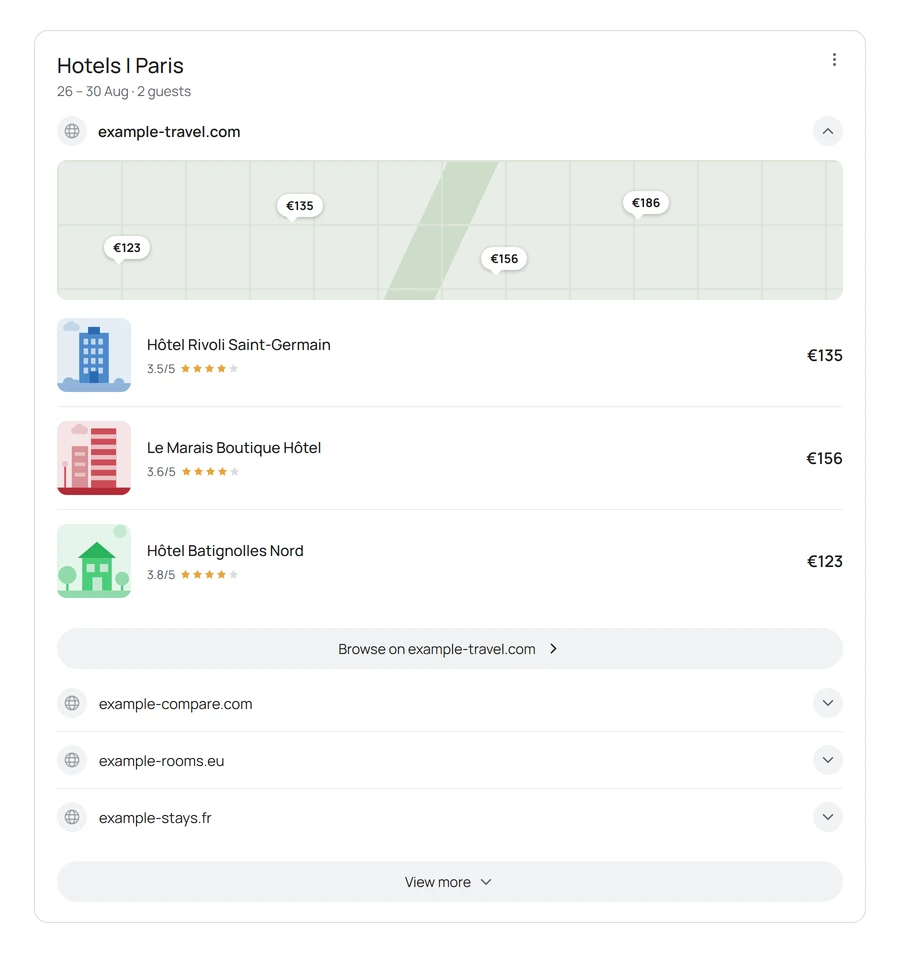
The first is a box of hotel listings drawn from a single comparison site: a map with nightly prices pinned to it, a short list of hotels with photos, star ratings and rates, and a button reading “Browse on” that site. Rival comparison sites sit collapsed in rows underneath, each one expandable in place, so the box swaps over to their listings. Google calls this the aggregator unit.
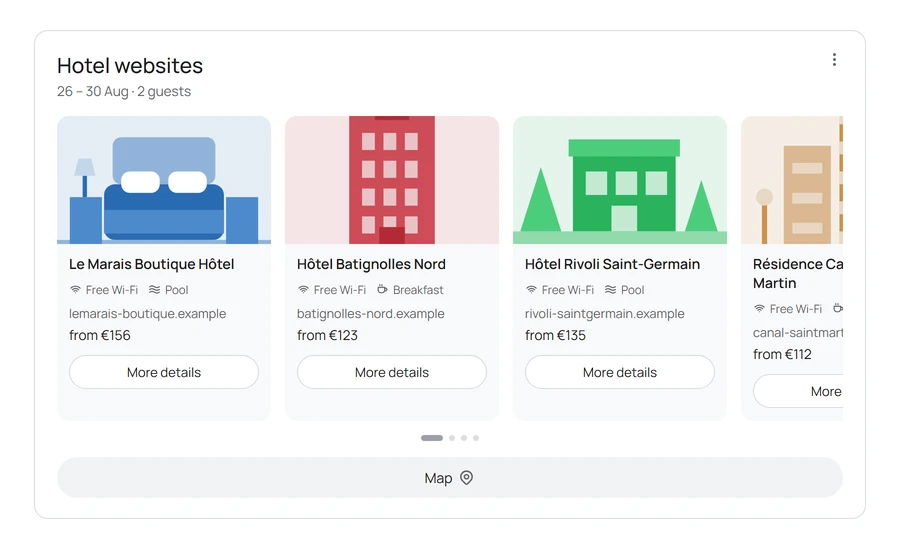
The second is headed “Hotel websites”. It is a swipeable row of cards, one card per hotel, each with a photo, amenity icons, a “from” price and a link to that hotel’s own website. Google calls this the supplier unit.
“Unit” is Google’s own word for a bordered block on a results page that groups several results together, as against a single blue link. You already know several: the local pack is a unit, so is the shopping carousel. What is new here is who fills them. One is for the middlemen, the comparison sites; the other is for the businesses themselves. Both occupy space Google used to fill with its own travel and shopping products.
Does this affect the UK?
No. The European Economic Area is the 27 EU member states plus Iceland, Liechtenstein and Norway. The United Kingdom left it on 31 December 2020, at the end of the post-Brexit transition period, and Switzerland has never been a member. Google’s documentation scopes both units to users in the EEA, and Google told Reuters that users outside the EU are unaffected. A search run from Manchester returns the same page it did last week.
Eligibility, though, is keyed to who a site serves rather than where it is registered. Google’s stated requirement for the supplier unit is that “your website must serve users in the EEA”, so a UK hotel or retailer selling into Europe can appear in a unit that its own domestic customers will never see.
What changed, and why now
This is the remedy behind the European Commission’s €460 million self-preferencing fine in July, the search half of an €890 million Digital Markets Act package. The Commission found that Google gave its own shopping, travel and transport results more prominence than comparable third-party services, and gave it 60 days to stop, a window that runs into late September.
The two units are Google’s answer: rather than demote its own products, it has built dedicated space for the competitors that complained.
Who can appear in each unit
Google published documentation for both units on 8 September, alongside a regional features hub listing which features exist in the EEA, Türkiye and South Africa, who qualifies for each and how to take part. Until now that meant piecing together blog posts and changelog entries going back more than two years.
The two paths are not comparable in cost.
- Aggregator unit. The site must be approved as a Vertical Search Service and supply data through a feed or a real-time API. Hotel aggregators provide a lodging feed, flight and transport aggregators connect through APIs, and product aggregators go through the Comparison Shopping Services programme. Google takes expressions of interest through two forms linked from its aggregator unit documentation: a Search aggregator features form for ground transport, flight and hotel queries, and the Comparison Shopping Services contact form for products. This is the path with real engineering work behind it.
- Supplier unit. A direct provider qualifies with a crawlable site serving EEA users. Google states that no data beyond what web crawling already reaches is required, though a feed can enrich the card. There is no application to make.
- Structured data carousels. A separate regional feature, and the one in the hub that Google gates on markup: an
ItemListcombined with a supportedLocalBusiness,ProductorEventtype, on a summary page covering at least three entities and linking out to a detail page for each.
Both units run on the same query types: hotels, flights, long-distance trains or buses, and products. The supplier unit carries a further condition that is easy to miss. It appears only when an aggregator unit appears, so a direct provider cannot secure it on its own merits; if no approved comparison site fills the box above, there is no card row underneath.
Google’s own definition of a direct provider is broader than the current rollout: individual hotels and airlines, but also brick-and-mortar business owners and service providers such as plumbers. None of those latter categories can appear yet, because the units do not run on local-service queries. A Google Actions Center page says dining, services and things-to-do queries are due to get the same two units, but Google has given no date and Search Central does not list them.
The units are also not the whole of the hub. The EEA table carries an ecosystem carousel for weather, sports, finance and translation queries, and a “Job sites” carousel and refinement chip for job queries.
Why Google says search quality will fall
Nick Fox, Google’s senior vice-president of knowledge and information, told Reuters the company is making “significant changes to Search in Europe” to meet DMA requirements, and that these “degrade the user experience for Europeans, boosting online intermediaries at the expense of local businesses, and removing helpful features people rely on every day.” Google described the redesign as the largest reduction in quality of service in Search’s 29-year history.
One figure from that account needs care. Google told Reuters that earlier DMA compliance changes cut free direct booking traffic to European businesses by 30%. That is Google’s own number, and it describes the earlier changes rather than this rollout, so it is not a measured effect of the aggregator and supplier units.
What the EEA redesign means for your search visibility
For hotel, flight, transport and product queries served to EEA users, visibility now depends partly on which side of the aggregator line a site sits. A comparison site gets a box that surfaces its own listings inside Search, but only after approval and the feed or API work that entry requires. A direct provider gets a card with nothing more than a crawlable site, and no way to make it appear when the aggregator box above it does not.
If you track rankings or read Search Console for EEA countries on these query types, expect the numbers to describe a different results page from the one the same queries return in the US or the UK. Country-filtered Search Console data, once there are a few weeks of it, will be the first real read on how traffic has moved.
Sources
- Google Rolls Out Redesigned Search Results Across The EEA, Search Engine Journal
- New Google Guide To Regional Search Features & Eligibility, Search Engine Journal
- Regional differences in Search experience, Google Search Central
- Aggregator unit, Google Search Central
- Supplier unit, Google Search Central
- Glossary: European Economic Area (EEA), Eurostat
- Google warns of lower quality as it revamps Europe search results to avoid EU fines, Reuters
- Commission fines Google €890 million for breaches of the Digital Markets Act, European Commission
More news
-
Google Stops Enforcing Site Reputation Manual Actions Inside the EEA
From 30 August 2026, a Google site reputation abuse manual action no longer demotes the offending section for searchers inside the EEA.
-
Google's Favicon Docs Confirm SVG Favicons Are Not Supported
Google's favicon documentation now names the seven formats it supports. Neither SVG nor WebP is among them, so an SVG-only favicon shows nothing in results.
-
Google Confirms It Is Routing Search Result Links Through a goto Redirect
Google has confirmed it is routing search result links through a google.com/goto redirect, a technical measure that makes results harder to scrape.