Google Defines Main Content and Calls Fabricated Author Profiles Deception

Google has added two passages to its Search Central page “Creating helpful, reliable, people-first content”, now dated 1 October 2026. One defines main content and the attributes quality raters judge it on; the other calls fabricated author profiles deception. The previous version was last updated 10 December 2025, and nothing was removed. Google’s documentation changelog records the same-day update to its generative AI content guidance but not this change.
What does Google count as main content?
The new section opens by saying Google’s Search Quality Evaluator Guidelines treat the quality of the main content as “one of the most critical factors for assessing page quality”. It defines main content as “any part of the webpage that directly helps the page achieve its purpose” and lists five kinds:
- primary text and media
- interactive features, such as calculators, tools, games and search
- user-generated contributions, “when they directly fulfill the page’s purpose”
- information behind tabs or expanded sections, such as product specifications, safety notes or reviews
- the visible title and headings
It then names four attributes raters are trained to evaluate: effort, originality, talent or skill, and accuracy. Accuracy is graded by topic: informational pages “should be factually accurate”, and pages on YMYL (Your Money or Your Life) topics “must be highly accurate and consistent with established expert consensus”.
How does the new text compare with the rater guidelines?
The four attributes are not new to raters. Section 3.2 of the rater guidelines, in the 11 September 2025 edition, uses the same four, and the Search Central text follows it closely. The effort example is where they differ.
The rater guidelines illustrate a lack of effort with “the automatic creation of thousands of pages by running existing freely available content through existing translation software without any oversight, manual curation”. The site-owner version uses generative AI instead: “using generative AI to produce large amounts of text without manual oversight or curation represents little to no effort.” The example is qualified by volume and oversight, and the rater guidelines separately state that “the use of Generative AI tools alone does not determine the level of effort”.
The new section also says “Attribution or giving credit to other sources doesn’t replace the need for original effort.” That matches section 4.6.6 of the rater guidelines, which tells raters to rate copied, paraphrased or AI-generated content Lowest “even if the page assigns credit for the content to another source.”
What does Google say about fake author profiles?
The second addition is a paragraph in the “Who” section, directly after the existing advice to add accurate authorship information such as bylines.
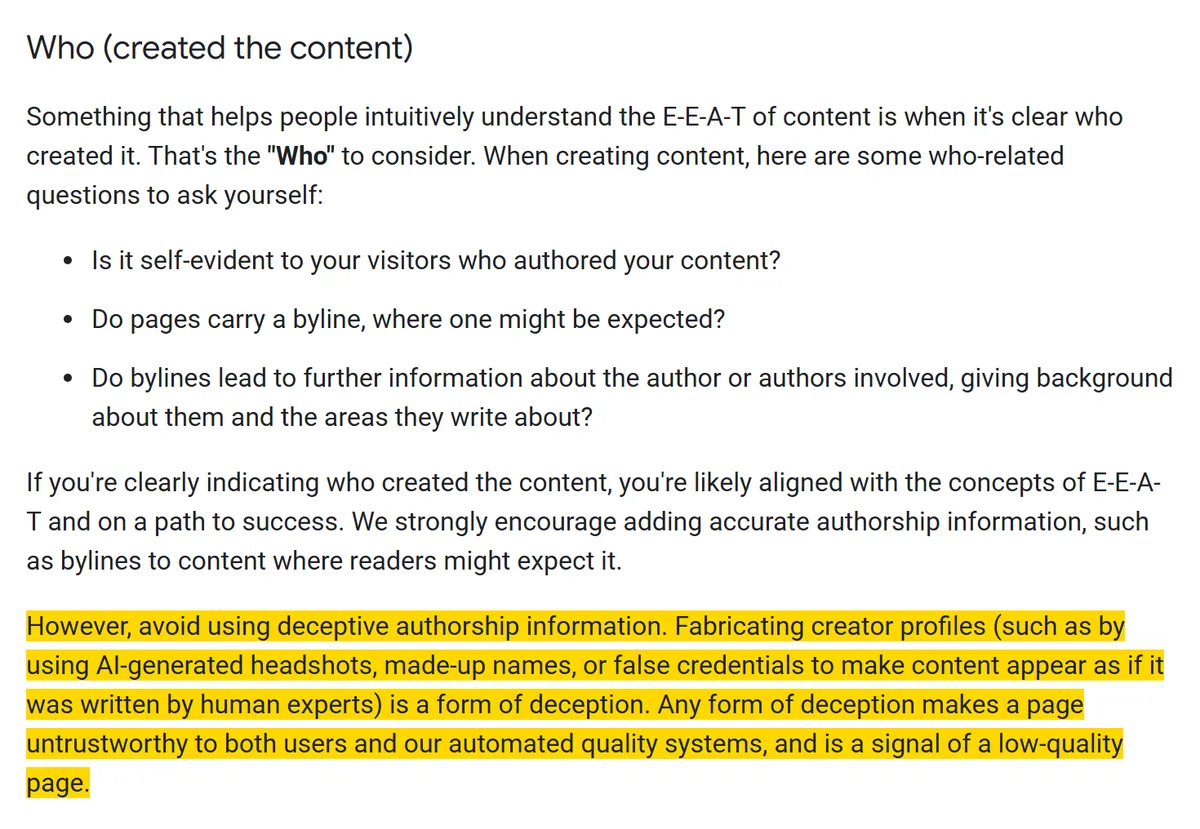
It says fabricating creator profiles, “such as by using AI-generated headshots, made-up names, or false credentials”, is “a form of deception”, and that any deception makes a page untrustworthy “to both users and our automated quality systems, and is a signal of a low-quality page.”
The rater guidelines already covered this. Section 4.5.3 lists “AI generated content with made up ‘author’ profiles (AI generated images or deceptive creator descriptions)” and false claims of credentials as deception, and tells raters that pages using deception of any type “should be rated Lowest”. The previous version of the Search Central page had no equivalent paragraph.
The new paragraph refers to automated systems rather than raters. The same page says raters “have no control over how pages rank” and that rater data is not used directly in Google’s ranking algorithms. It does not say how the automated systems would identify a fabricated profile.
What the two additions mean for AI-assisted publishing
Both passages put the line in the same place as the fact-check instruction Google added to its generative AI guidance the same day: AI output published without a human reviewing it, or presented as a human expert’s work. Neither passage names drafting with AI as a problem.
A site that publishes under invented author names, AI-generated author photos or unearned credentials is now doing something Google’s guidance for site owners names as a low-quality signal to its automated systems, not only something its rater guidelines penalise. The same section still encourages accurate bylines.
Sources
- Main content section, Creating helpful, reliable, people-first content, Google Search Central
- Who (created the content) section, Creating helpful, reliable, people-first content, Google Search Central
- Previous version, last updated 10 December 2025, Wayback Machine
- Latest documentation updates, Google Search Central
- General Guidelines (Search Quality Rater Guidelines), 11 September 2025, Google
- Google Adds Fake Author Warning To Helpful Content Guidance, Search Engine Journal
- Google says main content is critical and describes how search quality raters evaluate it, Search Engine Land
More news
-
Google Says It Is Critical to Fact-Check AI Content Before Publishing
Google's generative AI content guidance now calls a manual fact-check of all AI output critical, extending the review to titles, alt text and structured data.
-
Google Business Profile Now Penalises Misuse of Its Support Channels
Google Business Profile's new policy on misuse of support channels says repeated false or bad-faith complaints can get all further complaints rejected.
-
Google Business Profile Posts: Unverified Contact Details May Be Removed
Google now says Business Profile posts with unverified phone numbers, email addresses or social handles may be removed. Use the Call now button instead.