Google Explains How to Send Feedback on a Ranking Update
Google launched the Google Search ranking hub on 24 November 2026, a section of its Search Central documentation about how Google ranks results and how it handles changes to ranking. Google describes it as “your central place to learn how Google ranks search results and to keep up with changes to our ranking systems”. It links to existing pages on how ranking works and on diagnosing a traffic drop, and adds three new ones:
- Our principles for ranking results names three: users come first, systems are consistent across all types of results, and standards are upheld through testing. It says web page listings, AI Overviews, carousels, images and videos are “evaluated using the same criteria”, and that Google adjusts rankings manually only to comply with legal obligations or apply its content policies.
- How to stay informed says when Google gives advance notice of a change and where it posts it. Google published it the same day it pre-announced the December 2026 core update.
- Submit feedback about ranking changes gives site owners a documented route for reporting a ranking update, and UK sites a new appeal.
The notice and feedback pages cover duties the UK’s competition regulator has placed on Google from 17 December 2026.
How do you send Google feedback on a core update?
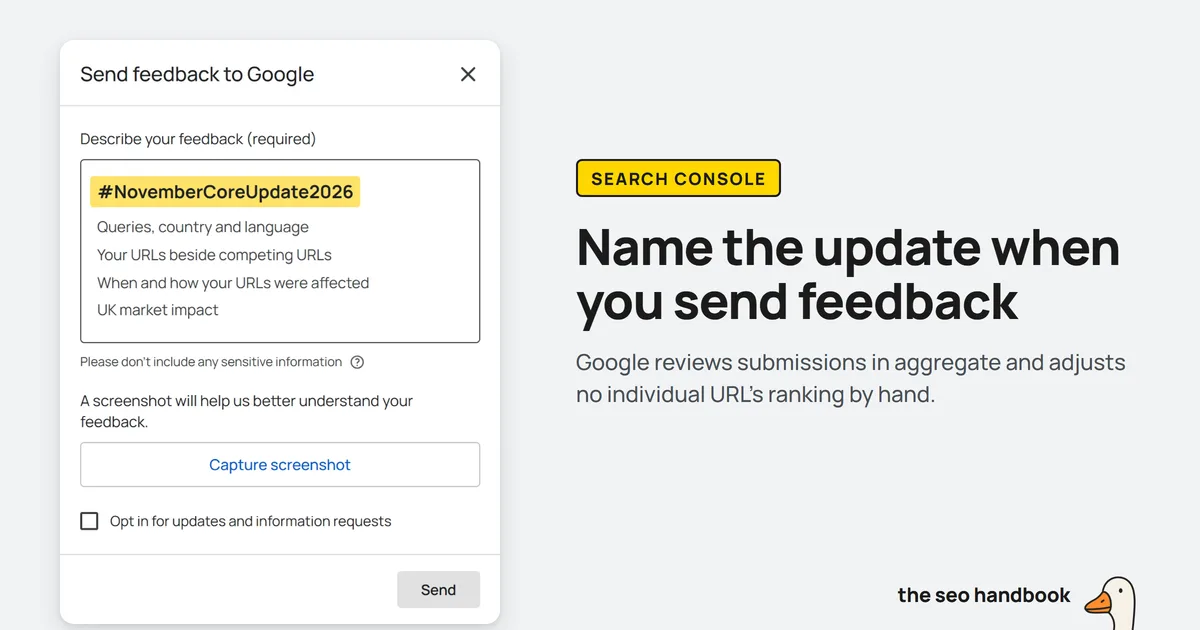
Once an update listed on the Search Status Dashboard rolls out, verified owners choose Submit feedback, near the bottom of Search Console’s left-hand menu. It opens a panel headed Send feedback to Google, where the message names the update as a hashtag. Google’s example is #NovemberCoreUpdate2026. The dashboard entries for the November and December updates carried no hashtag on 24 November, so follow the pattern in that example. Google recommends including:
- a snapshot of the Performance report
- the exact queries, with country and language
- your affected URLs beside competing URLs that appear to rank inappropriately
- when and how your URLs were affected
- why the current results fail searchers, with before-and-after impressions or position
- how the change affected a UK market you are active in
Feedback does not restore a page’s position. Google’s page says:
Engineering teams review submissions in aggregate to identify systemic issues and make Search better for everyone. Submitting feedback doesn’t result in manual ranking adjustments for individual URLs.
What counts as feedback under the UK’s fair ranking rule?
The Competition and Markets Authority (CMA), the UK’s competition regulator, requires Google to run a feedback process under its fair ranking requirement, in force from 17 December 2026. If at least 50 different publishers send feedback on a material change within 30 business days of its UK rollout finishing, Google must report it to the CMA with copies of the submissions. Repeat submissions from one publisher count once, and separate brands and sites in one group count separately.
The CMA’s notes say the process is not intended to capture two kinds of feedback:
- objections to the express purpose of the change, or the policy behind it
- complaints solely about one publisher’s ranking changing relative to another’s
A complaint that your site dropped and a competitor rose is the second kind.
What else changes for UK sites on 17 December?
- Indexing appeal. A site that serves UK users, and that Google has manually excluded from its index as a whole, can appeal through a form that opens that day. Sites in the European Economic Area already have an appeal under the Digital Markets Act.
- Manual actions. The CMA expects a substantive response to a reconsideration request within 14 business days, except in exceptional circumstances. Google’s page gives no period.
What to do before sending feedback on a ranking update
- Wait for a week of data. Google says to wait until an update is marked complete, plus at least a week of data, before evaluating it. For the November update, completed on 24 November, that means after 1 December.
- In the UK, describe the market. A submission meant for the CMA process needs to describe the effect on a UK market as well as on your own pages.
- Leave out anything confidential. Once the 50-publisher threshold is met, the CMA expects copies of the individual submissions.
Sources
- Google Search ranking hub, Google Search Central
- Our principles for ranking results, Google Search Central
- Submit feedback about ranking changes in Google Search, Google Search Central
- How to stay informed on Google Search ranking updates, Google Search Central
- Ranking history, Google Search Status Dashboard
- Latest Google Search documentation updates, Google Search Central
- Fair ranking conduct requirement notice, CMA (PDF)
- Fair ranking conduct requirement interpretative notes, CMA (PDF)
- New Google Search Ranking Hub, Search Engine Roundtable
More news
-
Google Maps Moves the Business Profile Message Button Next to Call
On Google Maps for Android and iOS, a Business Profile's chat option now sits in a Message button beside Call, so a dead link or unread inbox is in plain view.
-
Restaurants Can Now Switch Off Third-Party Ordering Providers in Google Business Profile
Restaurants can now turn individual ordering providers off for pickup, delivery or both from the Business Profile dashboard, without asking the provider.
-
Google Tells Platforms to Keep Link-Shared Pages Out of Search
Google's user-generated spam guide now covers AI tools and share-link products, and says pages made for sharing should stay out of the index by default.