Search Console Platform Properties Now Available Worldwide
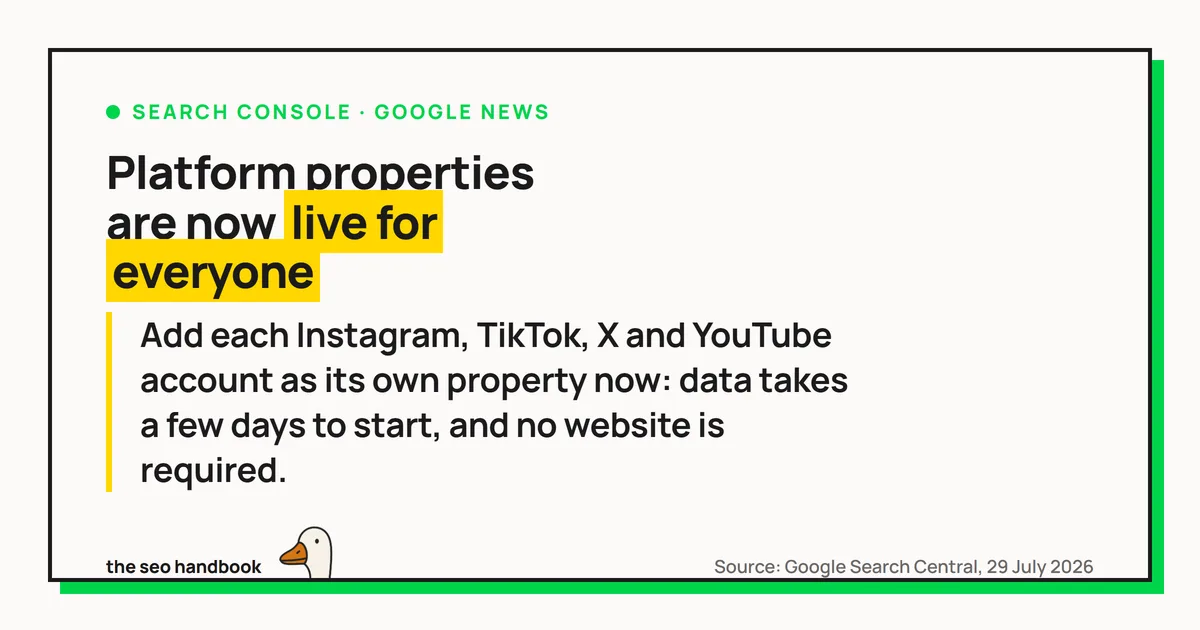
Platform properties, the Search Console property type that reports how your social and video posts perform on Google, are out of gradual rollout. Google confirmed on 29 July 2026 that they are available to everyone worldwide, three weeks after announcing the feature on 7 July. Google also published a guide to analysing the data, and the documentation confirms the reporting covers Google News alongside Search and Discover, with the Discover and News views appearing only once your content earns traffic from those surfaces.
If you post on Instagram, TikTok, X or YouTube, add each account now: open the property selector, click Add property, then Add next to the platform and authorise the login. There is no DNS record or file upload, no website is required, and each account or channel needs its own property. Data takes a few days to appear, so adding them today is what makes next month’s comparison possible. If you have claimed a Google Search profile, your verified accounts are already there.
Three things in the data are worth checking once it populates, none of which have an equivalent on a site property. Query groups in the Insights report show which search themes are trending up and down, which is keyword research for your next caption or video topic. The 24-hour filter in the Performance report catches a post gaining sudden search traction while cross-promoting it still matters. Page filters separate formats inside one account: /watch against /shorts/ on YouTube, /p/ against /reels/ on Instagram. Note the boundary before you read too much into any of it, though, since these reports cover Google Search performance only and say nothing about how a post did on the platform itself.
Sources
More news
-
Google Search Console Drops June Indexing Data With No Backfill
Google Search Console's page indexing report is missing several days of June 2026 data, and Google says it will not be backfilled.
-
Google Business Profiles Add a Collected Info Tab
Google Business Profiles now have a Collected info tab where owners can review details Google's automated assistant gathered, and delete inaccurate ones.
-
Google Cuts the Search Profile Threshold to 10,000 and Adds Multi-Account Support
Google has lowered the Search profile follower threshold to 10,000 and now lets one account manage up to 10 separate profiles, aimed at publishers running several brands.