Search Console API Adds Branded, Multimodal and Multi-Country Filters
Google’s Search Console team announced on 16 November 2026 that three features already in the Performance report are now in the Search Analytics API, the interface behind custom dashboards, scripts and third-party tools that pull Search Console data. Until now, API users had to keep their own brand regex lists, could not request multimodal data at all, and needed a separate request per country or device.
What did Google add to the Search Analytics API?
The announcement, from Daniel Waisberg, Nati Yosephian and Karin Gadasi of the Search Console team, lists three options:
- Branded queries. Group or filter by
brandedClassificationto compare branded and non-branded performance. As in Search Console, Google says this works only for eligible properties, and “for other properties, the response won’t include any rows.” - Web multimodal. Setting
typetowebMultimodalreturns performance data from Google Lens, Circle to Search on Android and image uploads in Google Search. Google says this data will also be available in BigQuery for properties with an active bulk data export. - Multi-country and multi-device filters. A new
filterListsfield filters by several countries or devices in a single request, so a regional total such as DACH or EMEA comes back as one query.
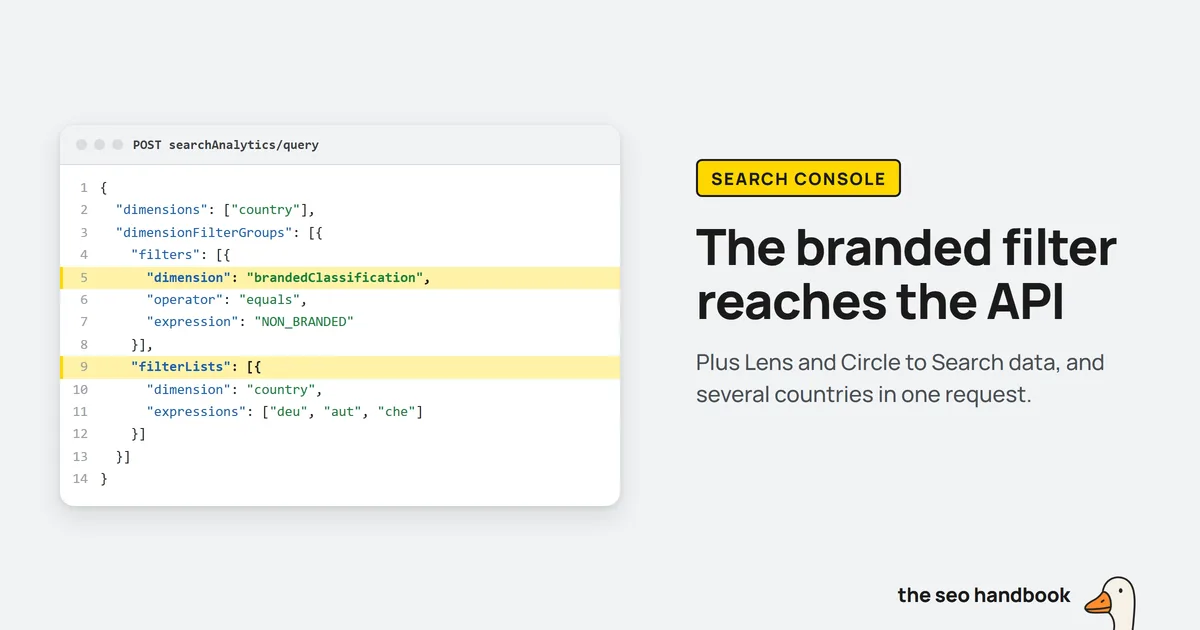
Google says the filters can be combined, for example branded traffic across a group of countries. This request body returns non-branded clicks and impressions for Germany, Austria and Switzerland, one row per country:
{
  "startDate": "2026-10-19",
  "endDate": "2026-11-15",
  "dimensions": ["country"],
  "dimensionFilterGroups": [{
    "filters": [
      { "dimension": "brandedClassification", "operator": "equals", "expression": "NON_BRANDED" }
    ],
    "filterLists": [
      { "dimension": "country", "expressions": ["deu", "aut", "che"] }
    ]
  }]
}
The other branded value is BRANDED, and equals is the only operator the branded filter accepts.
What should you change in API-based reporting?
If a dashboard or script splits branded from non-branded traffic with a regex list, brandedClassification can replace it on a qualifying property, and Google’s classifier recognises brand variations, misspellings and brand-related product names that a hand-built list has to spell out one by one. The branded queries filter is available only on top-level properties with enough query volume. The Search Analytics API reference sets its other limits, and three of them keep the regex in use:
| Limit | What a report should do |
|---|---|
| A property that is not eligible gets no rows | Treat an empty result as “not available”, not as zero branded clicks, and keep the regex for that property |
| No branded data before 21 February 2026; a request for earlier dates returned no rows rather than an error when tested on 19 November 2026 | Use the regex for comparisons reaching further back, such as a year-on-year split around the November 2026 core update |
Cannot be combined with a query filter, and the request fails if it is | Use the regex to slice branded traffic by query text |
One dimension cannot appear in both filters and filterLists | Put each dimension in one or the other |
Multimodal traffic was missing from API-fed reports when Search Console added it to the Performance report in September, because the API had no type for it. Add a webMultimodal request if image-led searches matter to the site. Regional totals that were built by adding up one request per country, the workaround before Search Console combined several countries in one filter, can now come from a single filterLists call.
Sources
More news
-
Search Console Under-Reported AI Impressions From 9 to 11 November
Google confirmed a logging error cut impressions in the Search Console Generative AI report from 9 to 11 November 2026, overlapping the core update's start.
-
Search Console Shows Unexplained Click Spikes for Some Sites
Some Search Console properties show a sudden jump in clicks with flat impressions. Google has not explained it. How to check whether your spike is real.
-
Google Calls 'Crawled - Currently Not Indexed' a Common Status
Google's Page Indexing report help now calls Crawled - currently not indexed common and not necessarily an issue, and points important pages to URL Inspection.