Google Search Console Adds Platform Properties for Social and Video Content
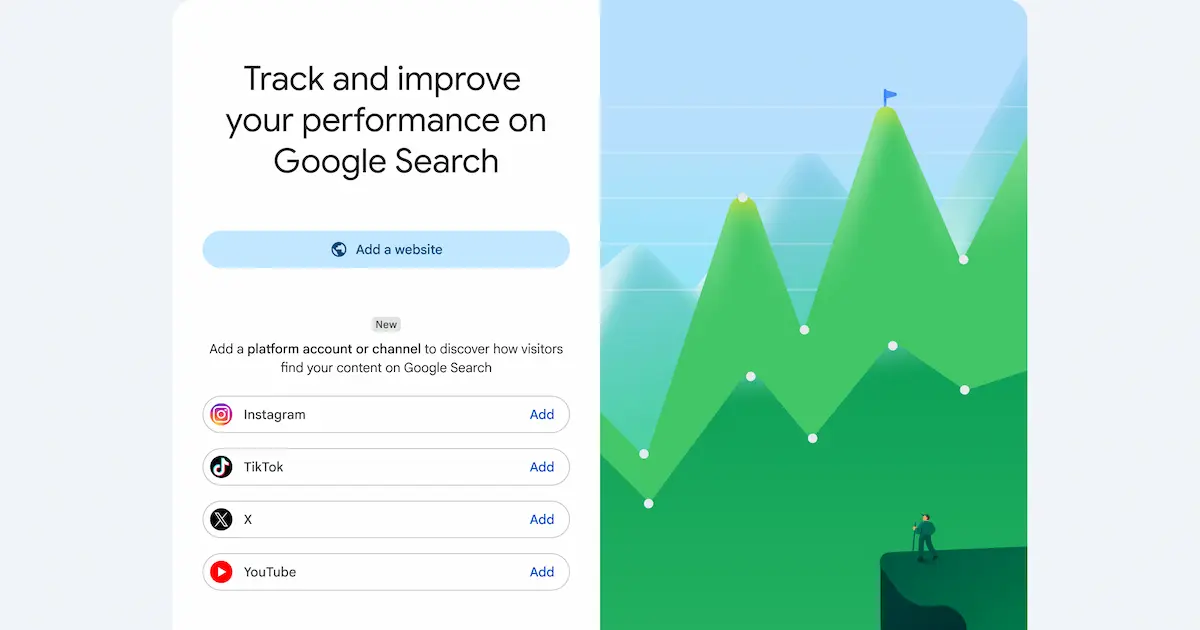
Google has introduced a new property type in Search Console, called platform properties, that lets creators and publishers see how their social and video content performs inside Google Search and Discover. Confirmed on the Google Search Central blog in July 2026, the feature covers posts hosted on Instagram, TikTok, X and YouTube, and works even for creators who do not run their own website.
What are platform properties?
Search Console has traditionally reported on sites you own and verify. Platform properties extend that reporting to content you publish on someone else’s platform. Once you connect a supported account, Search Console treats your presence on that platform as a property and shows how its posts appear in Google’s results.
The reporting mirrors what a standard Search Console property already gives you. The Performance report displays clicks, impressions and related metrics, with filtering and sorting so you can see which individual posts and which search queries drive the most visibility. The Insights report and the achievements section pick up the same social and video data.
The practical shift is that a creator whose reach lives on TikTok or YouTube, rather than on a website, can now measure how that content surfaces in Google Search directly, instead of inferring it from platform-native analytics.
Which platforms and who can use it?
At launch the supported platforms are Instagram, TikTok, X and YouTube. Availability does not depend on owning a website: the property is tied to the connected social or video account, which opens Search Console reporting to creators who have never verified a domain.
Google said at announcement that platform properties would roll out gradually over the coming weeks. That rollout finished on 29 July 2026, when Google confirmed the property type is available to everyone worldwide and published a guide to analysing the data. Google’s documentation also confirms the reporting covers Google News alongside Search and Discover, with the Discover and News views showing only where your content earns traffic from those surfaces.
What this means
For most site owners this does not change day-to-day technical SEO, because it reports on off-site social content rather than on your own pages. Its value is measurement clarity: if part of your discovery happens through social and video posts that show up in Google Search, you now have first-party numbers for it instead of guessing.
For creator-led brands the signal is more pointed. Google is making the search performance of social content legible inside its own SEO tool, which reinforces that visibility in Search now spans more than the pages you host yourself. Treat the new reporting as an additional lens on where your audience actually finds you, and confirm the specifics against Google’s own Search Console documentation as the rollout completes.
Sources
More news
-
Google Rebuilds European Search Results for Hotels, Flights and Products
Google's search results in the EEA now carry two new blocks for hotel, flight, transport and product queries. The UK is not in the EEA and is unaffected.
-
Google Stops Enforcing Site Reputation Manual Actions Inside the EEA
From 30 August 2026, a Google site reputation abuse manual action no longer demotes the offending section for searchers inside the EEA.
-
Google's Favicon Docs Confirm SVG Favicons Are Not Supported
Google's favicon documentation now names the seven formats it supports. Neither SVG nor WebP is among them, so an SVG-only favicon shows nothing in results.