Study: AI Search Collapses Onto Identical Answers When Models Cite AI Content
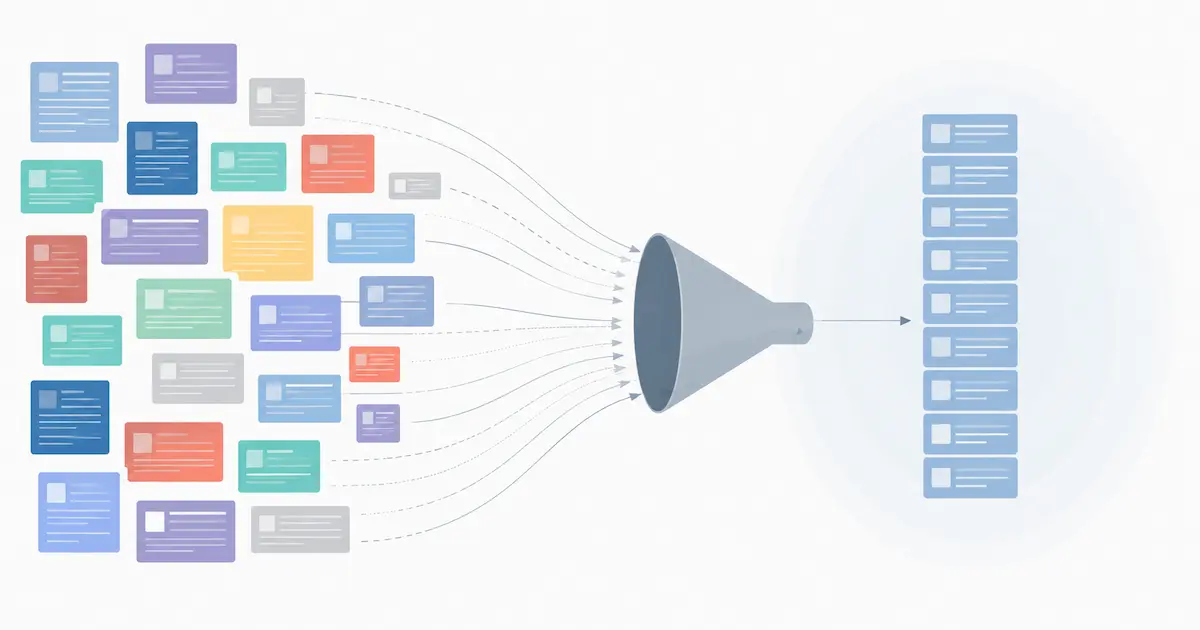
A June 2026 study from Graphite found that AI search systems tend to collapse onto a single, near-identical answer when the content they retrieve is itself AI-generated. Across 1,528 simulations, 79.6% (1,216 of 1,528) ended in collapse: the same entities, cited in the same order, regardless of how the question was first answered.
This is a cross-platform finding, not a single search engine’s behaviour. The simulations used three different model families, so it speaks to how retrieval-augmented AI answers behave in general, rather than to Google, Perplexity or any one product.
What the study found
Graphite ran 1,528 simulations across 1,019 unique questions, involving more than a million LLM API calls. It tested three model families: OpenAI’s GPT-5.2, Google’s Gemini 3 Pro, and Anthropic’s Claude Sonnet 4.5. Each simulation repeatedly answered a question, then fed AI-generated references back into the retrieval pool to see whether the answers would diverge or converge over time.
The headline numbers:
- 79.6% of simulations (1,216 of 1,528) collapsed onto the same set of entities in the same order.
- Collapse was most aggressive when every reference was swapped for AI-generated content each round (88–95%), and slightly lower when AI articles were merely added to an existing retrieval pool (73–77%).
- Models showed a strong self-preference: AI-generated references the model had itself authored were cited 38.9% of the time, against 9.4% for other AI-generated content and 7.4% for human-written sources. The gap persisted even after controlling for quality.
The study also found that even a single self-authored reference could begin to trigger collapse, and that low-visibility entities (those appearing in few responses to begin with) dropped out consistently as the loop tightened.
Why this matters for GEO
The mechanic is a feedback loop. As more of the web is written by AI, models increasingly retrieve and cite AI-generated content, and they disproportionately favour content that reads like their own output. Each round narrows the field, and the entities already in the answer get reinforced while everything else falls away.
For generative engine optimisation, the implication is uncomfortable but clear: incumbency compounds. The first credible, well-grounded source to define an entity tends to get locked in, and a rising tide of AI-generated filler entrenches whoever is already being cited rather than surfacing new sources. Late, undifferentiated content faces a steeper climb than the raw volume of competition would suggest.
This reinforces, rather than overturns, the things that already earn AI citations: being a clearly attributable, well-structured, factually grounded source on a defined entity, early. It also raises the value of being a distinctive primary source (original data, first-hand reporting, named expertise) over content that paraphrases what is already in the pool, because paraphrase is exactly what collapses.
What this means
A few practical takeaways:
- Treat entity establishment as time-sensitive. If your site should be the reference for a topic or product, being early and well-grounded matters more than the study’s authors’ framing of “model collapse” might suggest at first glance.
- Prioritise content an AI cannot generate from the existing pool: proprietary data, original research, first-hand testing, and clearly credited expertise. These are the sources that resist collapse.
- Do not assume volume helps. Publishing more AI-paraphrased coverage of a contested topic feeds the loop rather than breaking into it.
The wider caution is about the web as a whole rather than individual sites. Graphite’s authors suggest platforms may need to filter AI-generated references or deliberately diversify results to preserve information pluralism. Whether they do is outside any publisher’s control, but the direction of travel is worth watching.
Sources
More news
-
Shopify Checkouts Now Register WebMCP Tools for Browser Agents
Browser agents can now fill in and place orders on eligible Shopify checkouts through WebMCP, with no merchant setup. Checkout type decides which qualify.
-
Site Update: View and Copy Pages as Markdown
Every article, guide, pillar page and news story on The SEO Handbook now has a Markdown version you can open or copy in one click.
-
Cloudflare's AI Crawler Defaults Arrive, With a New Opt-Out That Protects Googlebot
Cloudflare's 15 September AI crawler changes are live: a plain Block now stops Googlebot, and a new setting opts out of AI training while keeping search crawlers in.