Study: Wider ChatGPT Search access cuts traditional search by 9.4%
A new working paper puts a causal number on something SEOs have watched build for two years: when people gain access to ChatGPT Search, they run fewer traditional searches, and AI search rarely sends a click back to the web. The paper, “Answering Without Referring: How AI Search Rewrites the Web’s Economic Bargain” by Qiaoni Shi, Kai Zhu and Kai Gu of Bocconi University, was posted to the arXiv preprint server on 8 July 2026.
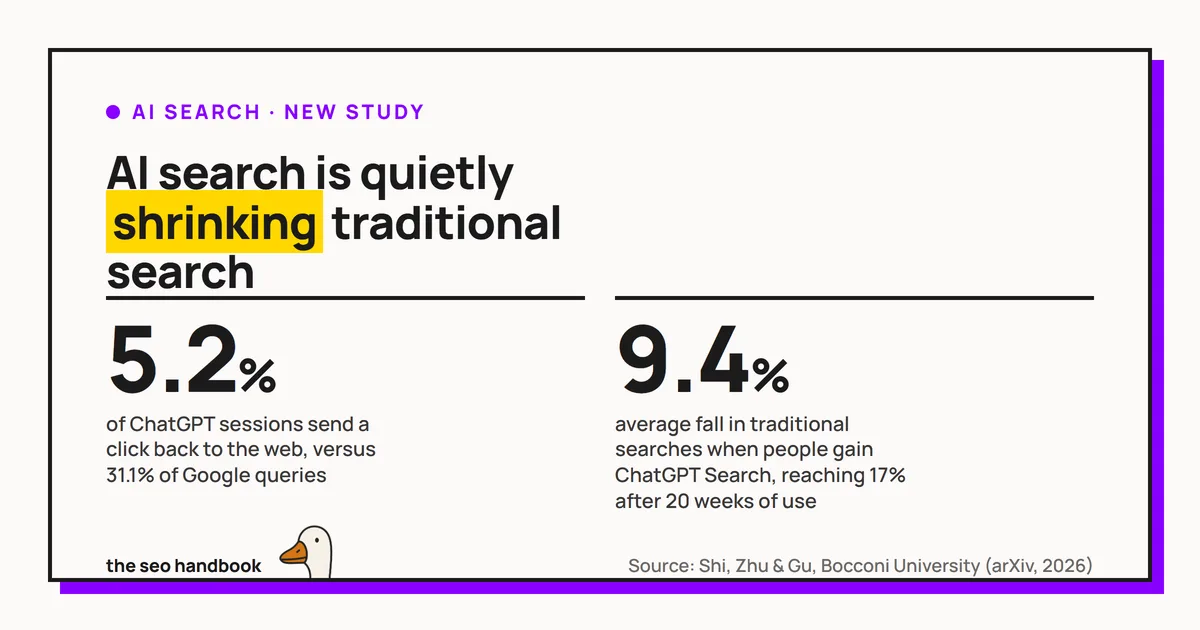
Its two headline figures measure different things. First, on the referral side, ChatGPT produces an outbound click in only 5.2% of conversation sessions, against 31.1% of Google queries. Second, on the demand side, the authors use expansions of ChatGPT Search access as a natural experiment and estimate that wider access cut traditional search use by 9.4% on average.
How the study was run
The paper draws on URL-level Comscore desktop clickstream records from US users, comparing information-seeking occasions on ChatGPT against those on Google. Rather than relying on survey recall, the authors observe what people actually did across both surfaces, then exploit the fact that ChatGPT Search rolled out to different tiers of OpenAI’s user base at different times. That staggered rollout lets them compare search behaviour before and after access, which is what turns a correlation into a displacement estimate.
The data covers Comscore desktop clickstream from October 2024 through July 2025, a window spanning the initial ChatGPT Search rollout, with the displacement analysis run on a balanced panel of 45,386 US households. The 9.4% average also masks a larger effect over time: the reduction deepens to 17.0% after twenty weeks of exposure, as people build the habit of asking rather than searching.
Which searches disappear
The displacement is not spread evenly. The losses concentrate in informational queries, the kind of question an assistant can resolve in place, while transactional and recreational searches barely change. Reference-style and academic lookups fall the hardest: search-engine referrals drop 26.5% for reference and knowledge sites and 32.8% for academic-research sites, which fits the intuition that “explain this” and “summarise that” are exactly the jobs a chatbot does without needing to hand you off to a page.
That pattern matters more than the top-line number for anyone planning content. It suggests the queries most exposed to AI substitution are the encyclopaedic, definitional, how-does-this-work searches, and the queries most insulated are those tied to a purchase, a booking, or entertainment.
Why “answering without referring” is the point
The title is the argument. Search engines allocated attention on the web by routing users from a query to a site, and that routing was the bargain: sites produced content, search sent traffic, traffic funded more content. AI search can satisfy the information need inside the intermediary, so the referral half of that bargain weakens. The 5.2% outbound-click figure is the mechanism, and the 9.4% demand reduction is the scale.
This is the same tension the site has covered from the measurement side. Work such as SimilarWeb’s downstream-impact study showed that AI influence often reaches a site later, as branded search rather than a visible AI referral, so the referral line understates AI’s effect. This paper approaches the other side of the ledger, the raw volume of traditional searches that stop happening at all. Both point at the same conclusion: judging AI’s impact by the size of the “ChatGPT” referral line in analytics reads a fraction of the picture.
What this means
Treat the numbers as directional. This is a preprint, not yet peer reviewed, and it covers US desktop only, so behaviour may differ on mobile and outside the US. The claims about ChatGPT’s behaviour apply to ChatGPT Search, not to AI search in general; Perplexity, Google’s AI systems, and Copilot each cite and route differently, and their referral economics should be sourced from their own data.
With those caveats, the direction is consistent with almost everything else measured this year. For anyone doing generative engine optimisation, the practical read is unchanged but sharper: informational, definitional content is the most exposed to being answered in place, so its value increasingly sits in the citation and the brand impression rather than the click. Content tied to a decision, a transaction, or a local action retains more of its direct-traffic pull. And measuring AI’s effect by referral clicks alone will keep undercounting it, because much of the loss is a search that never runs and much of the gain is a branded query that never looks like AI.
Sources
More news
-
People Also Ask Answers Hit 97% AI-Generated, After April's Slump to 11%
AlsoAsked measured 97% of English PAA answers as AI-generated in early September, up from 11% in April. The same curve has reversed twice this year.
-
ChatGPT Now Cites Twice as Many Sources, and Listicles Lost Half Their Share
GPT-5.6 searches more and scopes searches to specific domains. Listicles and comparison pages lost citation share, but the pool they compete in doubled.
-
Shopify Finishes a 10-Month Expansion of Its Theme Performance Docs
Shopify has concluded a rewrite of its theme performance best practices, including a page on speed apps that cheat testing tools, and built the docs for agents.