Blocking Internal Search Pages Is No Longer a Google Requirement
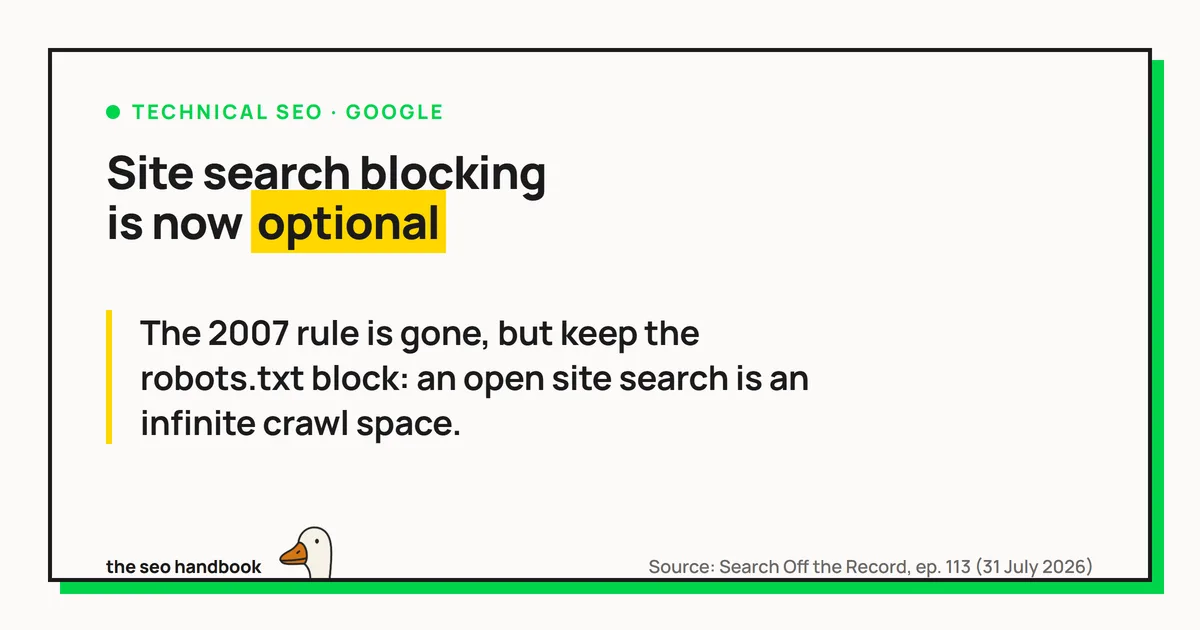
Blocking Google from crawling your internal search result pages is no longer a documented requirement in Search Essentials. John Mueller confirmed this on the Search Off the Record podcast (episode 113, “Should you block your Search result pages?”, 31 July 2026), noting that the instruction had been in Google’s guidelines since roughly 2007. An indexed internal search page is, by itself, no longer a policy violation.
The recommendation, though, has not gone anywhere. Mueller and Martin Splitt were clear that you should usually still block these pages, just for technical reasons rather than because a rule says so. Left crawlable, a site’s search function can turn into an infinite crawl space that traps Googlebot and burns crawl budget. Worse, an indexable site search can be hijacked by spammers to spin up thousands of junk pages, at which point Google may start treating them as a hacked-site signal, and that becomes a site-quality problem capable of dragging on rankings.
The takeaway is a small audit rather than a change of practice: confirm your internal search result URLs are still blocked, and treat it as a quality and security measure, not a box-ticking exercise against a guideline that no longer exists. Mueller pointed to robots.txt as the cleanest option, since it stops the crawl before Googlebot ever wanders into the search space.
Sources
More news
-
Google Search Console Drops June Indexing Data With No Backfill
Google Search Console's page indexing report is missing several days of June 2026 data, and Google says it will not be backfilled.
-
Google Business Profiles Add a Collected Info Tab
Google Business Profiles now have a Collected info tab where owners can review details Google's automated assistant gathered, and delete inaccurate ones.
-
Google Cuts the Search Profile Threshold to 10,000 and Adds Multi-Account Support
Google has lowered the Search profile follower threshold to 10,000 and now lets one account manage up to 10 separate profiles, aimed at publishers running several brands.