ChatGPT Citations Shift When Its Hidden Search Pipelines Switch
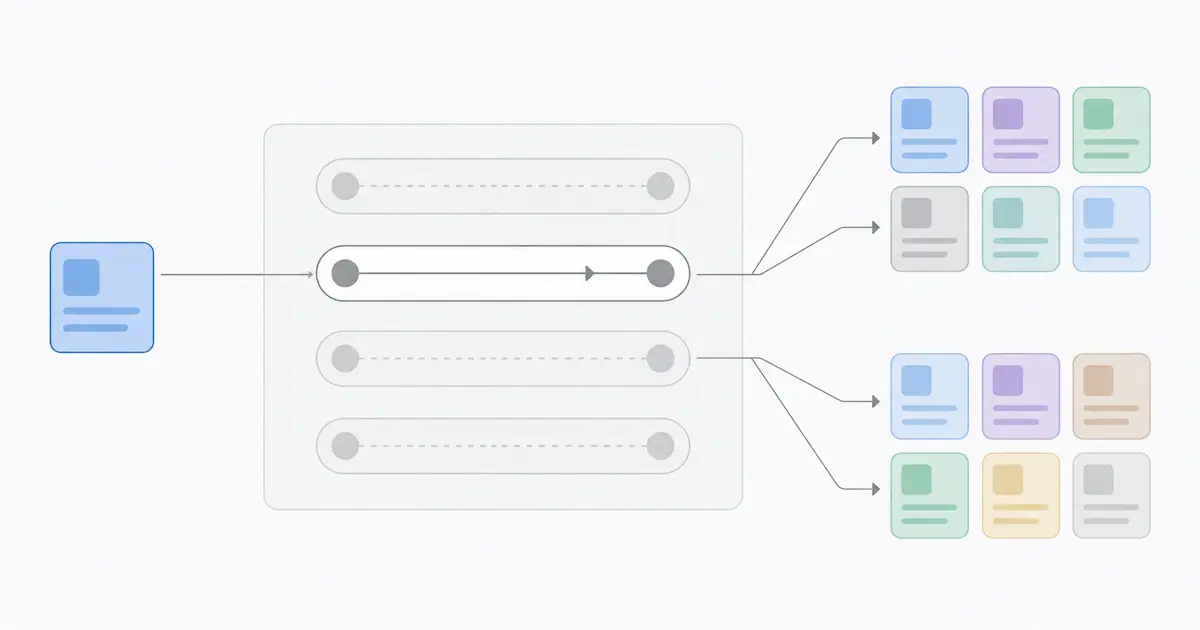
Two independent analyses of how ChatGPT selects sources suggest its web search is not one retrieval system but several, and that the sources it cites can change depending on which one answers a given query. The work, from search practitioners Chris Green and Suganthan Mohanadasan, and building on Metehan Yesilyurt’s earlier discovery of a hidden result_source field, was written up by Search Engine Land on 8 July 2026. The findings are unconfirmed by OpenAI and drawn from inspecting network traffic rather than official documentation, so they should be read as observed behaviour rather than a stated design. But if they hold, they complicate a task that is already central to AI search work: measuring whether your content is being cited.
What are ChatGPT’s hidden search pipelines?
Both researchers report that behind ChatGPT’s visible citation cards sits a source-selection layer identifying which retrieval pipeline supplied the underlying results. They independently observed the same four labels: Labrador, Bright, Oxylabs and SERP. These names do not appear in the answer a user sees; they sit in the traffic beneath it.
Each pipeline appears to draw on a different mix of the web. Mohanadasan describes Labrador as weighted towards established publishers and reference sites, Bright as tied to the data provider Bright Data, Oxylabs as tied to the provider of the same name, and SERP as an open-web baseline that surfaced mostly in news-style results.
Where the two diverge is on how much work each pipeline does. Green’s dataset, the larger of the two at 1,000 prompts run up to ten times each for 9,946 completed search runs, was dominated by a single pipeline: Labrador accounted for 88.1% of primary search sources, followed by Bright at 9.9%, Oxylabs at 1.7% and SERP at 0.3%. Mohanadasan, working from a much smaller sample, saw Bright play a far larger role, particularly on commercial, shopping, finance, weather and local queries. He is explicit that his own percentages should not be generalised: they come from tens of queries on a single account, skewed by his choice of SaaS and tech topics.
Read together, the two samples suggest the split is not fixed but depends heavily on the kind of query being asked. The mechanism is the corroborated part; the distribution is not.
Why does this matter for citation tracking?
The more consequential finding is what happens when the pipeline changes. Across repeated runs of the same prompts, Green found that 11.6% switched to a different primary pipeline between runs. When the pipeline stayed the same, the cited sources were fairly stable. When it switched, the overlap between the two sets of citations fell sharply: URL overlap dropped from 0.273 to 0.149 and domain overlap from 0.265 to 0.155, which Green calculated as roughly 45% lower URL overlap and 42% lower domain overlap.
In plain terms, asking ChatGPT the same question twice can return substantially different sources, not because your content changed or because a competitor out-optimised you, but because a different retrieval pipeline answered the second time. For anyone building AI visibility reports on citation rate or share of voice, that is a source of noise that sits entirely outside the content being measured. A single-run check of “does ChatGPT cite us for this query?” may capture the behaviour of one pipeline on one occasion rather than a stable answer.
What this means for AI search measurement
The lesson is about method, not panic. AI visibility measurement already differs from traditional rank tracking: the unit is inclusion in a synthesised answer, not a ranked position, and the metric is citation rate rather than click-through. This research adds a further wrinkle specific to ChatGPT. Because the platform appears to route queries through multiple retrieval systems with different source preferences, a citation result from a single prompt on a single day carries more variance than a keyword ranking does.
The response is to measure ChatGPT citations across repeated runs and over time rather than treating one check as definitive, and to read short-term swings with caution before attributing them to your own changes. The gap between the two researchers’ samples reinforces the point: if the pipeline mix shifts with query type, then a citation check on your commercial queries may behave quite differently from one on your informational queries, and neither result generalises to the other.
It is also a reminder of where the durable work sits. None of this is a lever you can pull directly, because you cannot choose which pipeline answers a query. What you can influence is whether your content is the kind any of these pipelines would surface, which points back to the same fundamentals that earn citations across AI platforms: clear, accurate, well-structured content from a recognisable source. These findings describe ChatGPT specifically; other AI platforms run their own retrieval stacks, and their citation behaviour has to be measured on its own terms.
Sources
More news
-
People Also Ask Answers Hit 97% AI-Generated, After April's Slump to 11%
AlsoAsked measured 97% of English PAA answers as AI-generated in early September, up from 11% in April. The same curve has reversed twice this year.
-
ChatGPT Now Cites Twice as Many Sources, and Listicles Lost Half Their Share
GPT-5.6 searches more and scopes searches to specific domains. Listicles and comparison pages lost citation share, but the pool they compete in doubled.
-
Shopify Finishes a 10-Month Expansion of Its Theme Performance Docs
Shopify has concluded a rewrite of its theme performance best practices, including a page on speed apps that cheat testing tools, and built the docs for agents.