Google revamps Image Search and brings image generation into AI Overviews
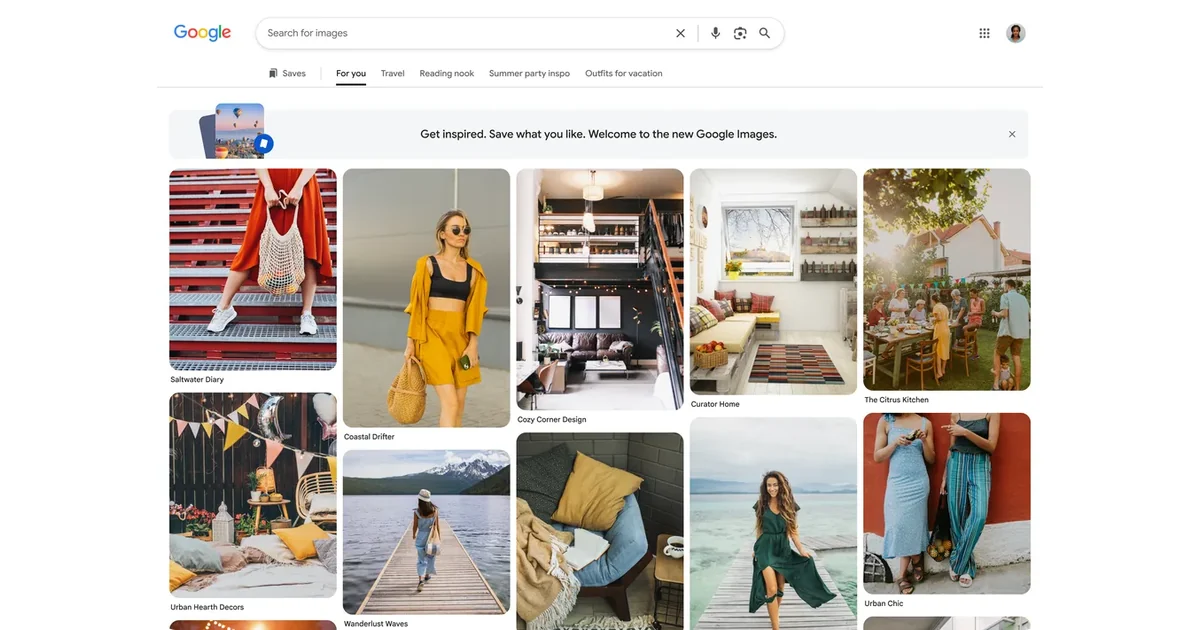
Google marked the 25th anniversary of Google Images on 14 July 2026 with two changes that pull in the same direction: less of a search box, more of a feed, and images that Google generates rather than retrieves. The Image Search home page is being rebuilt as a personalised gallery, and AI Overviews are gaining the ability to create images from a text prompt. Both are US and English-first, rolling out over the coming weeks, and both are Google’s systems only.
A gallery replaces the Image Search home page
The clean search box that has fronted Google Images for most of its life is being replaced with what Google calls a “brand new browseable home”: a dynamic gallery of images from across the web, updated in real time and tailored to a signed-in user’s interests. As you save ideas to your collections, those collections appear as tabs above the main gallery, so you can jump back into a theme you were exploring.
This is a landing-surface change, not a change to the results shown for a specific query. But the shift in default behaviour is the point. The Image Search home moves from “type what you are looking for” to “here is a feed we think you will like,” in the same way Discover reframed the Google app home. Discovery on that surface becomes something Google curates from signals about you, rather than something you initiate with a query.
It rolls out over the coming weeks on desktop in the US in English, and you need to be signed in to a Google Account to see it.
Image generation comes to AI Overviews
The change with clearer SEO implications is the second one. Google is bringing image generation directly into AI Overviews, powered by its Nano Banana model. A text prompt describing an image that does not yet exist is turned into a custom, high-quality visual inside the Overview, without leaving Search.
Google frames this as filling the gap that retrieval cannot: sometimes the right image is already on the web and Search surfaces it, and sometimes you have a specific idea for an image that no one has published. Image generation in AI Overviews handles the second case.
It rolls out over the coming weeks in English, for all regions that currently support image creation in AI Mode, so its geographic reach is wider than the Image Search home redesign from the outset.
What this means for SEO
Two effects carry different weight.
The Image Search home redesign is a discovery change to watch, not yet a measurable traffic change. It affects the home page, not the results returned for an image query, so it does not directly change how a specific image ranks. What it does change is how people arrive at images when they are browsing rather than searching, and that leans on personalisation signals rather than query-to-page relevance. The direction is worth monitoring in Search Console’s Image tab; the magnitude is unknown and, at a US-desktop-English launch, small for most sites for now.
Generated images expand the set of “answers” Google can produce without a click. For a query where a user wants to see something that does not exist as a real photograph, a concept, a mock-up, an illustration, Google can now satisfy that intent with a synthetic image inside the Overview instead of sending the user to a page. That is the same zero-click dynamic AI Overviews already created for text, now extended to imagery. It does not threaten queries that need a real image of a real thing, where retrieval from the web still applies, and it does not replace the reasons to publish original photography, product shots, diagrams, or brand imagery. But for illustrative and conceptual image intents, generation is a new competing answer.
There is also a provenance angle. Images produced by Google’s models carry SynthID watermarking, so AI-generated visuals in Search are marked as such. That does not change what you publish, but it is part of the same trend the handbook has tracked: content credentials becoming a routine expectation for imagery, whoever produced it.
Nothing here calls for a change to image SEO fundamentals. Descriptive filenames, accurate alt text, structured data, fast-loading and appropriately sized files, and images that genuinely belong to the page still decide whether your real images get retrieved and surfaced. The shift is in what Google can do alongside retrieval, not in what earns a retrieved image its place.
Sources
- Celebrating 25 years of visual search innovation — Google
- Google adds image generation to AI Overviews, revamps Images — Search Engine Journal
- Google Image Search drops clean search box and adds gallery of images — Search Engine Land
- Google AI Overviews now lets you create images — Search Engine Land
- Google Image Search home page goes from simple search box to gallery — Search Engine Roundtable
- AI image generation now within Google AI Overviews — Search Engine Roundtable
More news
-
Google Rebuilds European Search Results for Hotels, Flights and Products
Google's search results in the EEA now carry two new blocks for hotel, flight, transport and product queries. The UK is not in the EEA and is unaffected.
-
Google Stops Enforcing Site Reputation Manual Actions Inside the EEA
From 30 August 2026, a Google site reputation abuse manual action no longer demotes the offending section for searchers inside the EEA.
-
Google's Favicon Docs Confirm SVG Favicons Are Not Supported
Google's favicon documentation now names the seven formats it supports. Neither SVG nor WebP is among them, so an SVG-only favicon shows nothing in results.