Gemini Searches for Brands It Already Knows, geoSurge Study Finds
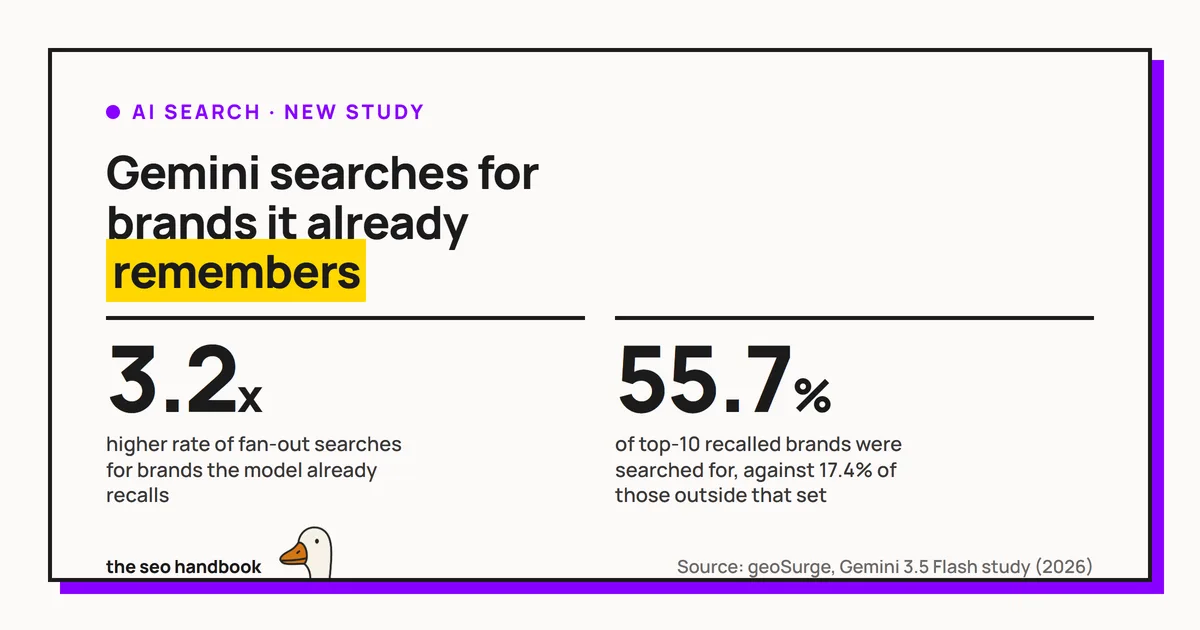
A study from AI-visibility firm geoSurge reports that Gemini is far more likely to run a web search for a brand it already recognises than for one it does not. In the test, Gemini 3.5 Flash issued fan-out searches for brands inside its own top-10 recall for a topic 55.7% of the time, compared with 17.4% for brands outside that set, a gap of roughly 3.2 times.
The claim is worth attributing carefully. It is geoSurge’s own research, run on one model, and the company sells tooling to help brands appear in AI answers. The methodology is unusually transparent for self-published research, but the headline figure describes Gemini’s behaviour in this specific test, not “AI models” as a class.
What geoSurge measured
geoSurge split the process into two stages: what a model remembers, and what it then searches for. Memory was defined as the model’s top-10 brands for a given topic, recalled before it fetches anything from the web and ranked by strength of recall. Search was the set of fan-out queries Gemini 3.5 Flash actually fired when answering a prompt. Crucially, memory was measured on a separate model from the one whose search behaviour was recorded, so the two signals were not read off the same output.
The sample was a public demo cohort: nine organisations, one per industry (travel, automotive, finance, business software, education, food and restaurants, luxury, fitness and wellness, and fashion), across 66 US prompts. Each prompt was answered 60 times, five iterations a day across a 12-day window from 29 May to 9 June 2026, giving 3,960 model responses that together fired 13,281 fan-out search queries.
Why model memory might sit upstream of search
The argument geoSurge draws from the numbers is that memory is not a by-product of search but a filter that runs before it. If a brand is already in the model’s recalled set for a topic, it has a head start: it can surface in the fan-out step before any page is fetched. A brand the model does not recall is far less likely to be searched for at all, which means the pages that might have earned it a citation never enter the running.
If that holds, it reframes part of the AI-visibility problem. Optimising a page to be citable assumes the model reaches the page. geoSurge’s data suggests that for Gemini, a meaningful share of the contest is decided earlier, at the point where the model decides which brands are worth a query in the first place.
geoSurge also frames AI visibility as closer to a binary state than a spectrum: a brand can be recalled and searched for, or effectively absent, with less of the gradual middle ground that traditional rankings offer. That framing suits a company whose product monitors exactly this, so it is worth holding lightly.
What this means for AI search visibility
The practical read, kept within what the study supports, is that brand familiarity is doing work in Gemini’s fan-out before conventional on-page optimisation gets a look in. The levers that build that familiarity are the same entity-strength signals that already matter for entity SEO: a consistent, verifiable presence across the sources a model is likely to have absorbed, unambiguous naming, and clear, fact-based content that is easy to attribute.
Two caveats should temper how far you run with the 3.2x figure. First, it is Gemini 3.5 Flash only. Other systems, from ChatGPT Search to Perplexity to Google’s own AI Overviews, run different retrieval and may weight prior familiarity differently, so this is not evidence about AI search in general. Second, this is geoSurge’s own dataset on a demo cohort, published by a company with a direct interest in the conclusion. The direction of the effect is plausible and consistent with how fan-out retrieval is understood to work; the exact magnitude is best treated as a signal to test against your own AI-visibility data, not a benchmark to quote.
Sources
More news
-
Cloudflare's AI Crawler Defaults Arrive, With a New Opt-Out That Protects Googlebot
Cloudflare's 15 September AI crawler defaults are live, alongside a new setting that lets sites opt out of AI training without blocking Google, Bing or Apple's search crawlers.
-
People Also Ask Answers Hit 97% AI-Generated, After April's Slump to 11%
AlsoAsked measured 97% of English PAA answers as AI-generated in early September, up from 11% in April. The same curve has reversed twice this year.
-
ChatGPT Now Cites Twice as Many Sources, and Listicles Lost Half Their Share
GPT-5.6 searches more and scopes searches to specific domains. Listicles and comparison pages lost citation share, but the pool they compete in doubled.